
Best Megasonic Cleaning System for Precision Cleaning
2026-10-02
When it comes to precision cleaning, not all megasonic systems are created equal. If you're tired of residues and damage from conventional methods, it's time to explore what Siansonic brings to the table. In this guide, we break down the features that make a megasonic cleaning system truly best-in-class—and why Siansonic's technology stands out in demanding applications.
What Makes Megasonic Cleaning Different from Ultrasonic?
The biggest separation point is the frequency band each process uses. Ultrasonic cleaning usually sits between 20 kHz and 400 kHz, generating cavitation bubbles that collapse hard enough to break up stubborn oil, carbon, and shop grime. Megasonic systems run much higher, typically from 0.8 MHz up to 2 MHz or more. Those rapid cycles produce far smaller bubbles with softer collapse energy. Instead of blasting contaminants off, they create a fine scrubbing and acoustic streaming effect that sweeps away tiny particles without eroding delicate surfaces.
That difference in bubble mechanics directly shapes the applications. Ultrasonic baths handle robust items like engine parts, tools, and metal fixtures that can tolerate aggressive cavitation. Megasonic cleaners are built for fragile, high-precision work: silicon wafers, photomasks, MEMS devices, and flat-panel displays. The higher frequency also shrinks the boundary layer where fluid sits motionless against a part, so cleaning solution can reach into submicron gaps and along fine patterns that lower-frequency waves tend to skip.
Energy delivery matters too. Many ultrasonic tanks mount transducers on the bottom, which can create standing waves and uneven cleaning zones across the bath. Megasonic tools often use a focused nozzle or a vibrating rod positioned close to the target surface. That closer coupling keeps acoustic energy concentrated and repeatable, reducing the chance of over-processing one area while leaving another untouched—an important edge in automated precision manufacturing lines.
Key Factors When Choosing a Megasonic System for Delicate Parts
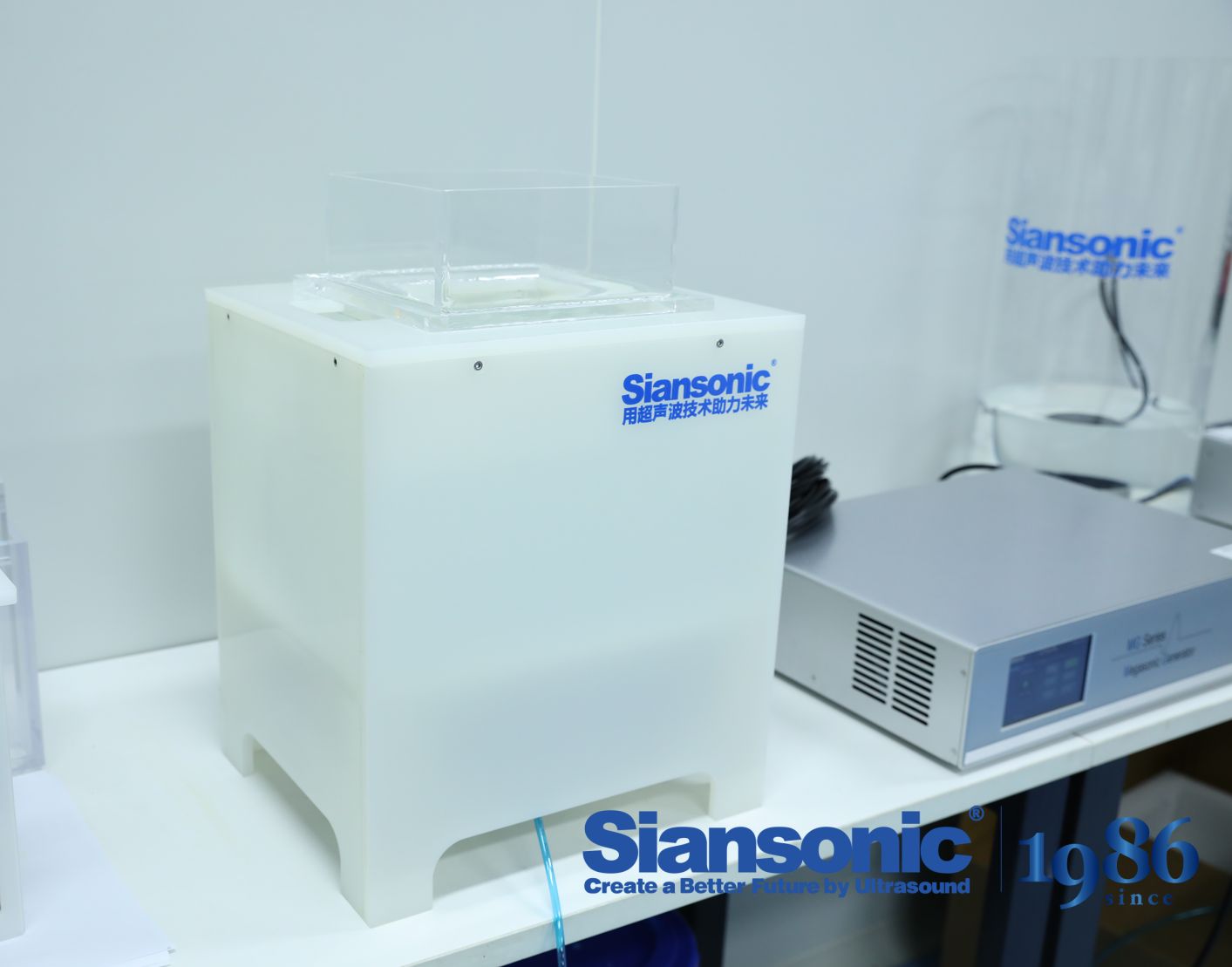
Choosing a megasonic system for delicate parts comes down to how finely you can control the energy that reaches the surface. Thin wafers, coated optics, and micro-machined components rarely fail from heavy contamination alone—they fail when cavitation becomes aggressive enough to etch or fracture fine features. Look for a generator that lets you dial in frequency and power independently rather than relying on fixed presets. A narrow, stable frequency band around 800 kHz to 1 MHz often works, but the real differentiator is how uniformly that energy is distributed across the tank or nozzle.
Transducer design matters just as much as the numbers on the screen. Bonded piezoelectric arrays tend to create dead zones and hot spots, which translates into uneven cleaning and hidden damage on fragile geometries. Systems with swept-frequency modulation can avoid standing waves, but only if the sweep range stays within the transducer's resonant bandwidth. Also check whether the chemistry and temperature are kept within limits the parts can tolerate—megasonic energy amplifies the effect of aggressive baths, so a system that works for robust metal parts may be far too harsh for gallium arsenide or thin-film coatings. The best choices are usually systems that allow real-time adjustment of power density, not just an on/off setting.
Real-World Applications: From Semiconductors to Medical Devices
The same defect-control strategies refined in semiconductor fabs now shape how we build implantable glucose sensors. A stray particle that once ruined a wafer can now trigger an immune response, so cleanroom discipline and thin-film encapsulation have migrated directly into medical manufacturing lines. This crossover is most visible in the production of MEMS pressure transducers, where sub-micron etching originally developed for accelerometers in smartphones now enables real-time intracranial pressure monitoring after traumatic brain injury.
Beyond implants, microfluidic cartridges for point-of-care blood analysis borrow heavily from photolithography and deep reactive ion etching. Instead of patterning transistors, engineers pattern capillary networks and reagent storage chambers on polymer or glass substrates. The result is a lab-on-a-chip that can separate plasma from whole blood and run a panel of assays in minutes, all because the surface chemistry and dimensional tolerances were perfected for semiconductor yield improvement. Even the coatings inside drug-eluting stents owe their uniformity to vapor deposition techniques first used for gate dielectrics.
How to Avoid Common Pitfalls in Megasonic Cleaning Processes
Running a megasonic bath at maximum power might feel like the quickest route to spotless wafers, but it often becomes a fast track to pitting and feature collapse. Instead of treating power as a dial to crank up, think of it as a variable that shifts the balance between particle removal and substrate stress. Higher frequencies—typically 800 kHz to 1 MHz—deliver finer cavitation that lifts contaminants without hammering fragile geometries, while lower frequencies can generate violent bubble implosions near surfaces. A practical safeguard is to map the safe energy window for each device pattern using a small set of sacrificial test pieces, then lock in a power density that leaves at least a 20% margin below the damage threshold.
Gas content in the cleaning liquid is one of the most overlooked variables, yet it quietly dictates how consistently your process behaves. Water straight from a facility line often carries dissolved oxygen and nitrogen at levels that fluctuate with temperature and pressure, leading to erratic bubble nucleation from one run to the next. Adding a dedicated degassing module before the tank keeps dissolved gas near a controlled set point, which stabilizes cavitation intensity and prevents sudden bubble streams that can scratch or shadow the surface. Rather than chasing perfect degassing, aim for repeatability—log the dissolved oxygen level and tie it to a known removal rate so shifts get caught before they turn into scrap.
Process drift usually announces itself as a slow rise in defect counts, long before anyone suspects the cleaning tool. Transducers age, tank walls pick up residues, and even minor changes in chemical temperature alter acoustic impedance and standing wave patterns. Set up a monthly acoustic field scan with a hydrophone or foil erosion test to reveal dead zones and hotspots that can't be seen by eye. Combine that with simple daily checks: verify the fluid level covers the transducers by the same margin, hold temperature within a tight band, and watch for any change in the characteristic hiss or surface ripple that signals a transducer losing output. When those baselines stay stable, the larger process tends to follow.
The Role of Frequency and Power in Achieving Sub-Micron Cleaning
Achieving sub-micron cleaning requires a careful balance between ultrasonic frequency and power, as these two parameters directly influence cavitation behavior and the resulting cleaning forces. Lower frequencies, typically around 20–40 kHz, generate larger, more energetic cavitation bubbles that collapse with greater intensity, making them effective for dislodging heavier contaminants from robust surfaces. However, this aggressive action can also damage delicate components or drive particles deeper into fine features. Higher frequencies, often above 100 kHz, produce smaller, gentler bubbles that implode more uniformly and can penetrate narrow gaps and microstructures without causing surface erosion, which is critical when working with precision optics, semiconductor wafers, or micro-electromechanical systems.
Power input, measured in watts per gallon or watt density, determines the density of cavitation events within the cleaning bath. Increasing power generally boosts cleaning efficiency by creating more bubble nucleation sites, but only up to a threshold beyond which excessive cavitation can lead to bubble shielding and reduced energy transfer. For sub-micron particle removal, moderate power combined with higher frequency often yields the best results, as it avoids the violent transient cavitation that can redeposit particles or etch sensitive substrates. Fine-tuning both parameters in tandem allows process engineers to target specific contamination types, from sub-micron polishing compounds to thin-film residues, without compromising the integrity of the part being cleaned.
Practical optimization frequently involves mapping frequency–power combinations against particle removal efficiency and surface damage metrics. Techniques such as sweeping the frequency slightly around a center value can help distribute cavitation energy more evenly, preventing standing wave patterns that leave dead zones. Similarly, pulsing the power input—rather than running at a constant level—can enhance cleaning uniformity while reducing the risk of cavitation erosion. By understanding how frequency and power interact, operators can achieve repeatable sub-micron cleanliness in high-precision industries, where even a few hundred nanometers of residual debris can cause device failure or optical scattering.
Maintaining Your Megasonic Cleaning System for Long-Term Performance
Megasonic systems rely on precise transducer calibration and clean tank chemistry. Even small shifts in frequency or detergent concentration can reduce cavitation efficiency and leave residues on sensitive parts. A weekly check of the power supply readings and a monthly sweep of the transducer face for mineral buildup will catch most issues before they affect cleaning results.
Fluid management matters as much as the hardware. Replace the cleaning solution on a schedule based on actual part throughput rather than visual clarity alone, since dissolved contaminants can suppress megasonic activity long before the bath looks dirty. Use filtered deionized water for rinses to prevent scale from forming inside the manifold and on the transducer surface.
Finally, pay attention to the little mechanical details: inspect O-rings and gaskets for swelling or cracks, keep tank lids closed when the system is idle to reduce evaporation and airborne contamination, and recalibrate the generator every six months or after any major tank repair. These habits extend the system's service life and keep cleaning performance consistent across every batch.
FAQ
A megasonic system uses higher frequencies, typically in the megahertz range, to generate gentle but highly effective acoustic streaming. This creates controlled cavitation that's much less aggressive than the lower-frequency ultrasonic baths, so it can clean delicate parts without causing surface damage. Ultrasonic relies on violent bubble implosion, while megasonic focuses on fluid flow and microstreaming to lift off contaminants.
Precision parts often have tight tolerances, fragile geometries, or sensitive coatings. Megasonic energy removes sub-micron particles without pitting, scratching, or altering the surface finish. The cleaning action reaches into deep trenches, blind vias, and other hard-to-reach areas that brushes or sprays can't touch.
It's effective against sub-micron particles, light organic residues, polishing compounds, and process films. However, heavy oils or thick greases usually need a chemical pre-treatment because megasonic alone may not break down robust hydrocarbon layers.
Semiconductor manufacturing, MEMS fabrication, optics, medical device production, and precision machining all depend on it. Any field where a single microscopic particle can ruin a component's performance is a strong candidate.
Focus on frequency control, power density uniformity, transducer quality, and tank or nozzle design. You also want a system that allows fine-tuning of energy delivery, because too much power can still damage sensitive parts even at megasonic frequencies. Material compatibility and ease of process validation matter as well.
Yes, many systems are designed for inline or cassette-to-cassette automation. They can be mounted as single-wafer or batch modules with robotics handling, chemical delivery, and drying stages. The key is ensuring the acoustic field remains consistent across all parts during high-throughput operation.
Regular inspection of the transducer and RF generator is essential. Monitor the cavitation intensity with a hydrophone or acoustic probe, keep the cleaning solution filtered and degassed, and replace any worn quartz or sapphire windows. Calibration checks should be part of the preventive maintenance schedule.
Not universally. While it's gentle compared to ultrasonic, some extremely fragile structures, thin membranes, or certain soft polymers may still be susceptible to acoustic energy. Always run coupon tests and adjust frequency, power, and exposure time before committing to a full process.
Conclusion
Megasonic cleaning stands apart from ultrasonic because it relies on higher frequencies, typically near or above 1 MHz, to generate gentler but extremely controlled cavitation. Instead of violent bubble collapse that can pit or crack delicate surfaces, megasonic energy pushes contaminants away in a more laminar-like stream, making it the go-to for wafers, MEMS, optics, and fine medical components. When choosing a system, you can't just look at tank size or brand reputation; power density, transducer placement, and the ability to sweep frequency matter more. A uniform acoustic field is what separates a mediocre cleaner from one that actually removes sub-micron particles without re-deposition. Frequency and power are linked: higher frequency improves resolution for tiny particles but lowers physical force, so a system that allows fine tuning across a range gives you the flexibility to clean fragile parts without damage.
Real-world use spans semiconductor fabs removing post-CMP slurry, medical device manufacturers prepping implants before passivation, and optics houses clearing polishing compound from lens surfaces. The common thread is that all of them battle the same pitfalls—cavitation erosion in corners, standing waves that leave dead zones, and contamination from the cleaning chemistry itself. Avoiding these starts with choosing a system that offers sweep or pulse modes, not just continuous output. Regular maintenance matters as much as the initial purchase: transducers degrade over time, fluid temperature shifts alter acoustic performance, and filters load up with particles. A well-maintained system with proper degassing and periodic transducer checks will hold its cleaning curve far longer than one that is simply switched on and forgotten.
Contact Us
Contact Person: Ivy Zhang
Email: [email protected]
Tel/WhatsApp: +86 1081502288
Website: https://www.siansonic.com/