
China Cleanroom Equipment Powers Advanced Manufacturing Worldwide
2026-11-27
The hum of a semiconductor fab and the sterile hush of a biopharma suite share a quieter dependency: precision cleanroom engineering. For years, China was viewed mainly as a cost-effective source of components. That reputation is rapidly becoming outdated. Today, Chinese cleanroom equipment—modular partitions, air showers, fan filter units, filtration systems—underpins advanced manufacturing lines from Southeast Asia to Europe, often outperforming legacy suppliers on both delivery speed and technical specification. At GENO Pharmatech, this evolution is visible in the equipment choices and facility standards that now shape everyday operations. The following sections look at how China moved from supplying cleanroom parts to defining cleanroom performance—and why that matters for manufacturers everywhere.
The Cleanroom Builders Behind the World’s Most Delicate Lines
The people who build cleanrooms rarely get mentioned when a new chip or display panel launches, yet their work sets the physical limits for every nanometre-scale line that follows. Their domain is not just a sealed room; it is a machine for removing uncertainty. Air pressure, electrostatic charge, vibration from a nearby highway, even the heat of a body standing too close to a wall, all have to be accounted for long before the first tool is bolted down.
A cleanroom builder might spend days sealing a single cable penetration or adjusting the angle of a return-air grille. The tolerances feel absurd from the outside. A ceiling panel that sags a few millimetres can redirect airflow just enough to trap particles around a photolithography tool, and that is enough to ruin an entire batch. They think in terms of microns of movement and counts of particles per cubic metre, but the job is not purely technical. It involves negotiating with architects, process engineers, and contractors who do not always agree on what “clean” means.
What makes the craftsmanship unusual is its invisibility. The most successful cleanroom builders leave behind spaces that feel almost blank: white panels, grey floors, a low hum of filtered air. Only the yield data later shows whether their decisions were right. And when a factory starts printing the world’s most delicate lines, the people who shaped that environment are usually gone, moving on to another site where the next impossible tolerance is waiting.
Precision Hardware That Travels From Yangtze Delta Factories to Fab Floors
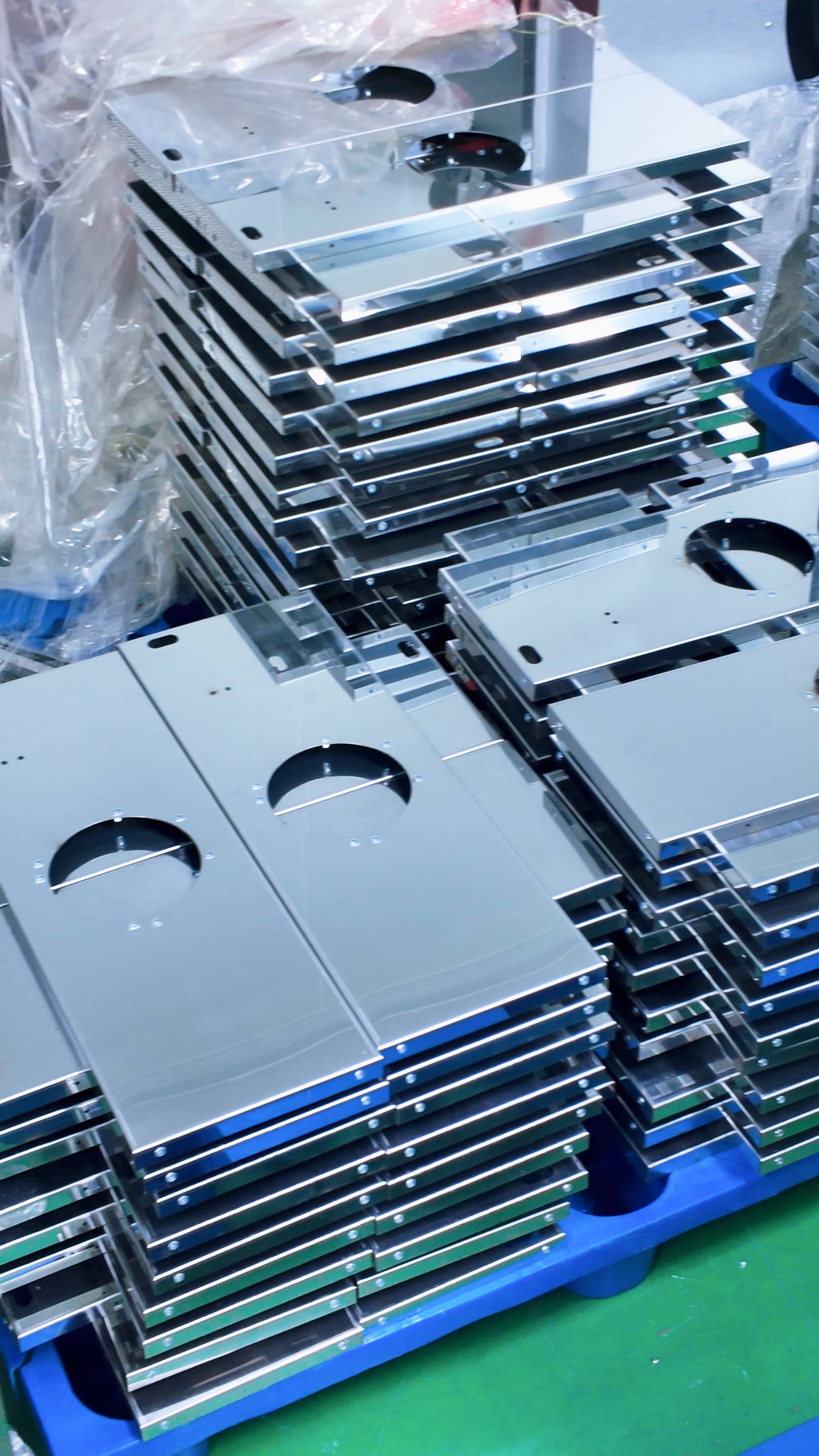
A stainless steel gas manifold leaves a machining shop in Wuxi with its bore surfaces checked to a fraction of a micron. By the following week it sits inside a semiconductor tool in Hsinchu or Singapore, bolted into a gas delivery line. This is routine for hardware from the Yangtze Delta, where dense clusters of small and mid-sized manufacturers produce the valves, flanges, chambers, and motion components that wafer fabs depend on. The distance is less important than the discipline: every part must arrive clean, dimensionally stable, and ready for ultrahigh-purity service.
The real work happens before shipment. Shops around Shanghai, Suzhou, and Ningbo often run separate cleaning rooms, use low-outgassing packaging, and map each lot to the material heat number. A 316L VIM/VAR remelt may be specified for a critical plasma-facing bracket, while a standard flange might still require electropolishing and particle-count verification. These are not off-the-shelf parts, but small-batch, traceable builds that move through inspection gates with the same care as the process tools they will support.
Once crated, the hardware travels by air freight or bonded truck, often with shock sensors and humidity indicators fixed inside the case. Fab receiving teams check certificates and cleanroom labels before the parts reach a subfab or maintenance crib. In that handoff, the Yangtze Delta factory effectively becomes an extension of the fab floor—its tolerances and paperwork quietly holding up a line that cannot afford surprises.
Airflow, Pressure Differentials, and the Math of a Missed Particle
A particle doesn't need a visible gap to cross a pressure boundary. When a cleanroom runs at 12.5 Pa relative to the adjacent corridor, the differential feels absolute on a manometer, yet the actual barrier is full of smaller negotiations. Door sweeps flex, cable penetrations settle, and return-air grilles pull room air into eddies that linger near the floor. A 0.5 micron particle caught in one of those eddies can drift against the intended cascade simply because its local velocity vector points the wrong way for a fraction of a second.
The uncomfortable math starts when you treat that fraction as a probability. If a pressure reversal lasts 0.8 seconds during a door cycle and the particle has roughly eleven chances per hour to sit in the affected zone, the missed-particle likelihood compounds quickly. Most contamination control plans assume steady-state differentials, but real airflow is a series of small, repeated coin flips. The particles that matter are not the ones you measure in the middle of the room. They are the ones riding a transient vortex near a gasketed seam, where the pressure gauge still insists everything is in order.
Where Semiconductor, Biopharma, and EV Battery Demands Overlap
The overlap is rarely obvious at the product level, but it becomes hard to miss once you trace material and process requirements. High-purity solvents, specialty gases, ultrapure water systems, particle counting, and contamination control appear again and again across semiconductor fabs, biopharma cleanrooms, and EV battery dry rooms. A shift in one sector's demand for a particular fluoropolymer or nickel-based alloy quickly tightens availability for the others, even when the end products share almost nothing.
Some of the most visible friction points sit in filtration, mixing, and coating. Semiconductor photoresist lines and biopharma downstream processing both depend on filters that can hold particle counts to levels most industrial buyers never need to specify. At the same time, slurry mixing for battery electrodes and high-shear formulation for certain drug products pull from the same pool of precision mixers, inline sensors, and clean-in-place expertise. The equipment itself may look different, but the validation and metrology behind it often come from the same suppliers.
This shared dependence shows up in lead times and qualification burdens. A supplier adding capacity for ultra-dry cleanroom infrastructure may be responding to orders from a gigafactory, a fab expansion, and a biologics plant in the same quarter. When those projects land together, common components such as high-purity valves, gas delivery manifolds, and humidity control systems become the real bottleneck, not the headline technologies. Reading those overlapping signals early is how procurement teams spot capacity constraints before they become public shortages.
Certifications That Matter Once the Crates Arrive in Another Time Zone
The first set of documents that causes trouble is rarely the one you expect. A packing list that describes goods in a slightly different order than the commercial invoice can look like a mismatch to an inspector who has never seen your product line. In many ports, the certificate of origin is checked against the regional trade agreement applied at the exact hour of entry, and if the tariff code on file does not match the code printed on the certificate, the shipment sits in a warehouse while local brokers try to reach someone in a time zone where it is still the middle of the night.
A product certificate that cleared the shipment in one country can be almost useless after the pallets are unloaded in another. Electrical goods may need the destination country's current energy label printed in the local language, not a PDF tucked inside the box. If the test report references a standard edition that was replaced six months before arrival, the local authority can refuse the consignment even though the physical product has not changed. The certificate only matters if it matches the rules in force at the receiving dock, not the rules in force when the order was signed.
For certain goods, the paperwork that protects you is not about marketing claims but about quarantine and liability. Wooden pallets without a visible ISPM 15 stamp can be held for treatment or re-export, and that stamp is inspected on the pallet itself, not on a separate sheet of paper. Food and pharmaceutical shipments often need batch certificates dated close enough to arrival that the receiving lab can trace the production window. If those documents are missing, insurance adjusters may treat the loss as a documentation failure rather than a shipping accident, which changes who pays for the delay.
Why Turnkey Cleanroom Enclosures Are Reshaping Project Timelines
Conventional cleanroom builds tend to drag because the enclosure work sits in the middle of a long chain of site activities. Walls, ceilings, cutouts, and filter housings are typically assembled after the building shell is ready, which forces mechanical and process teams to wait before they can start positioning tools and running utilities. Turnkey enclosures break that sequence. The panels, doors, glazing, and seal interfaces are prepared off-site under controlled conditions, so the on-site phase behaves more like assembling a pre-engineered instrument than doing building work. That overlap between factory preparation and site readiness removes a large block of dead time from the schedule.
A less obvious time saving comes from having the design frozen earlier. Instead of resolving dimensional conflicts, load paths, and sealing details through back-and-forth site revisions, the project team works with a defined system of standard interfaces and pre-calculated structural data. Cutouts for ducts, electrical penetrations, and pass-throughs are already coordinated before the enclosure reaches the floor. Installers spend their time connecting, leveling, and sealing rather than cutting and reworking panels in place, which turns a process that often took weeks into a few days of controlled assembly.
Commissioning also moves faster because the enclosure arrives with much of its performance already verified. Factory testing covers surface finish, joint alignment, and leak paths before shipping, so the on-site checks focus on installation boundaries rather than hunting for systemic defects. That reduces the familiar cycle of test, patch, retest, and document. For renovation projects especially, the ability to sequence numbered modules through tight existing spaces means less site storage, fewer lifts, and fewer interruptions to surrounding operations. The overall effect is that project timelines start to follow the enclosure schedule instead of being held hostage by it.
FAQ
Many buyers first notice the combination of modular design and shorter lead times. Chinese manufacturers have also invested heavily in automated production for fan filter units, pass boxes, and air showers, which keeps repeat orders consistent without long waits.
Semiconductor packaging, pharmaceutical filling, medical device assembly, and flat panel display production are the biggest users. Some aerospace and battery labs also source laminar flow carts and pass-through chambers from Chinese suppliers when they need clean zones quickly.
Most export-focused factories now design around ISO 14644 and EU GMP expectations as a baseline. They typically provide third-party test reports for particle counts, airflow uniformity, and filter integrity, though buyers should still confirm the specific certificate before purchase.
It often comes down to speed and flexibility. A Chinese supplier can usually customize panel dimensions, door directions, or control systems within weeks, while some local providers quote much longer delivery windows for the same changes.
Fan filter units, air showers, pass boxes, clean benches, and modular wall systems dominate. In recent years, complete prefabricated cleanroom kits have also grown because they let overseas teams assemble a controlled environment without hiring specialized local contractors.
Quality varies by factory, so it is less about the country and more about the supplier's track record. Reputable manufacturers offer factory acceptance testing, video inspections, and clear documentation for filters, motors, and control panels before shipment.
The rapid expansion of local semiconductor, EV battery, and biotech plants created a large internal test market. That volume pushed suppliers to refine energy-efficient airflow designs and digital monitoring features, which now appear in export models as well.
Look for detailed material specs, not just product photos. Ask about filter brand options, motor certifications, PLC compatibility, spare parts availability, and whether the supplier can support remote commissioning. A factory that asks about your process requirements is usually more reliable than one that quotes immediately.
Conclusion
Across China’s lower Yangtze corridor, cleanroom construction has shifted from a support trade into a precision discipline. The teams that assemble these controlled environments now routinely handle projects where a single misplaced particle can scrap a wafer lot or spoil a biologic batch, so their work blends structural engineering with contamination physics. Panels, fan filter units, pass-through chambers, and modular framing leave regional factories with tolerances measured in fractions of a millimeter, then arrive on fab floors in Southeast Asia, Europe, and North America ready for alignment. Airflow patterns and pressure cascades are mapped long before installation, because the real specification is not just how much air moves, but where it does not linger. This same rigor lets suppliers serve semiconductor fabs, biopharma suites, and EV battery dry rooms from one engineering base, even though each sector watches different particles, humidity bands, and chemical exposures.
Once crates clear customs in another time zone, the conversation turns to documentation. Buyers increasingly ask for ISO class reports, material certificates, and test data that match what was actually shipped, not a generic brochure. Chinese equipment makers have responded by tightening traceability and aligning with cleanroom validation protocols familiar to international commissioning teams. At the same time, turnkey enclosure packages are changing project schedules. Instead of waiting for separate vendors to coordinate walls, HVAC, electrical drops, and flooring, owners can bring in a pre-engineered envelope with most integration points already resolved. That reduces the gap between building shell and process qualification, which matters when production deadlines are set in months rather than years.
Contact Us
Contact Person: Amy Yang
Email: [email protected]
Tel/WhatsApp: 008619330882686
Website: https://www.genopharmatech.com/