
Custom Cleanroom HVAC Systems: Tailored Solutions for Critical Environments
2026-10-04
Most cleanroom failures don’t begin with a loud alarm or a sudden pressure drop. They start quietly—with an HVAC system that was never truly designed for the space it serves. In pharmaceutical manufacturing, medical device production, or advanced research, off-the-shelf air handling logic leaves narrow gaps in temperature, humidity, and particulate control that only surface during audits, product loss, or failed batches. Custom cleanroom HVAC systems close those gaps by treating every critical environment as its own operating challenge, not a standard template. At GENO Pharmatech, tailored zoning, precise filtration cascades, and adaptive controls come together to protect both product integrity and compliance. This post explores what custom really means, where standard designs fall short, and how the right HVAC strategy turns a vulnerable cleanroom into a dependable, audit-ready asset.
Why Cookie-Cutter HVAC Designs Fail in Critical Environments
Critical environments don't behave like ordinary office spaces, and their HVAC systems can't either. A laboratory, a cleanroom, or a hospital isolation suite has tightly coupled requirements for temperature, humidity, filtration, and room-to-room pressure that shift with ongoing work. A cookie-cutter design pulled from a commercial template may hit the nominal cooling tonnage yet miss the subtle interactions that keep the space stable—such as maintaining negative pressure between a procedure room and the corridor, or preventing humidity spikes during high-load procedures. These gaps rarely show up during commissioning; they surface later as biological contamination, condensation on instruments, or failed process runs. By then, retrofitting ducts and replacing air handlers costs far more than the initial savings.
Standardized HVAC packages also tend to minimize redundancy to keep upfront costs low. In critical environments, losing a single compressor or supply fan must not mean losing control of the entire zone. Off-the-shelf designs, however, often rely on single-point equipment or standby capacity that's barely enough for comfort conditions. That's a different world from the continuous operation required in a biosafety lab or a data center. The control logic suffers as well: a simple on/off thermostat or a fixed setpoint cannot handle rapid swings from full occupancy to idle states, nor can it adjust supply air dew point and volume based on real-time internal loads or outdoor weather. The system ends up hunting, room parameters drift, and staff resort to manual overrides that create their own risks.
Duct layout and airflow distribution are another area where generic templates fail. Critical spaces need air to move in specific directions—from clean to less-clean zones, around sensitive equipment without creating dead spots or re-entrainment. A copied design usually routes ducts along the easiest path and places diffusers for coverage only, ignoring how particles disperse or how heat concentrates near certain instruments. Corners become stagnant pockets, and supposedly exhausted contaminants get pulled back into the work area. Once the room is operational, these airflow defects can't be fixed by simply adjusting dampers or upgrading filters because they're baked into the duct geometry and diffuser selection. That structural mismatch is why a plug-and-play HVAC approach rarely survives contact with a truly critical environment.
Mapping Airflow to Equipment Heat Loads and Operator Movements
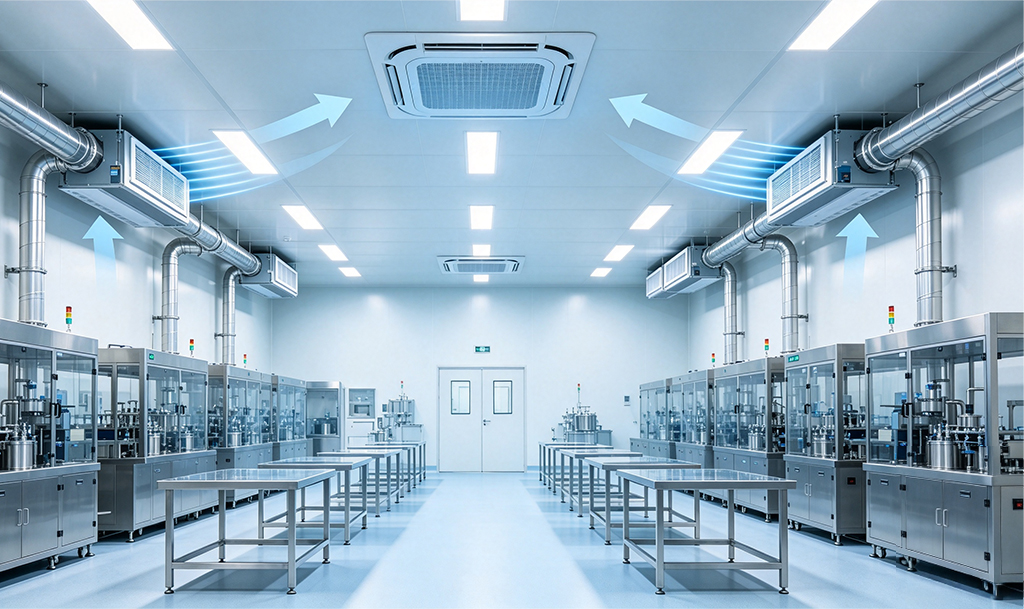
Linking airflow patterns to heat loads from equipment starts with identifying where the thermal energy actually concentrates. Racks with high-density servers don't just emit heat uniformly; they create buoyant plumes that rise and interact with cooler supply air. By measuring temperature differentials across inlet and outlet faces, facilities teams can adjust perforated tile placement or containment strategies to keep hot air from recirculating into cold aisles. Small changes in underfloor pressure often shift the balance enough to prevent hotspots without adding cooling capacity.
Operator movements introduce a variable that static airflow models rarely capture. People moving through aisles disrupt laminar flow, pulling warm air across cold aisles or blocking return paths momentarily. In high-traffic areas, this turbulence can raise rack inlet temperatures by several degrees, even when the overall cooling system is sized correctly. Mapping these movements against floor-level airflow sensors reveals corridors where activity peaks align with temperature drift, allowing targeted adjustments like repositioning supply vents or adding local airflow guides rather than overhauling the entire layout.
The practical payoff comes from treating both heat load and human traffic as overlapping layers on the same airflow map. Where sensor data shows repeated spikes tied to shift changes or maintenance rounds, small interventions such as sealing cable cutouts or installing brush grommets can preserve cold aisle integrity. Over time, this combined mapping approach lets operators fine-tune cooling delivery with far less guesswork, matching real thermal demand instead of relying on nameplate ratings or worst-case assumptions.
The Hidden Cost of Over-Filtration in Small Cleanrooms
Most operators of small cleanrooms assume that adding more filters or bumping up to a higher efficiency rating is a safe way to guarantee air quality. In practice, this often backfires. A compact cleanroom doesn't have the air-handling headroom of a large facility, so every extra Pascal of pressure drop across an over-specified HEPA or ULPA bank forces the fan to work harder. The result isn't just a higher utility bill—it's a system that runs closer to its operational limits, leaving no margin for filter loading or unexpected demand. Within a few months, the hidden cost shows up as accelerated motor wear, louder operation, and the need for more frequent prefilter changes just to keep airflow within spec.
Beyond energy, there's a quieter operational penalty. Over-filtration in a small footprint tends to distort the very airflow patterns that cleanroom classification depends on. Instead of gentle, uniform laminar flow, you get dead zones near corners, turbulence around equipment, and uneven pressure cascades between adjacent rooms. Technicians then compensate by adjusting dampers or boosting fan speed, which only compounds the problem. The real expense is measured in lost production time: repeated particle count failures, debugging sessions that eat into shift hours, and the slow realization that the “better” filter was never the right tool for the space.
Perhaps the most overlooked cost is the maintenance burden that creeps in silently. Because over-filtered systems clog faster—especially in small cleanrooms where makeup air may carry more particulate from nearby processes—the replacement cycle shrinks. Each changeout means downtime, labor, and disposal fees, but more importantly, it introduces risk. Every time a ceiling grid is opened or a housing seal is broken, there's a chance of contaminating the very environment you're trying to protect. Over years of operation, these small disruptions add up to a pattern of instability that no amount of extra filtration can fix.
Pressure Differentials That Survive Door Openings
In most well-balanced ventilation systems, a door opening is enough to flatten the pressure gradient between two spaces within seconds. But in hospitals, cleanrooms, and laboratories, some differentials hold up even with the door swung wide. This isn't accidental. It comes from deliberately oversized supply or exhaust air, airflow tracking that responds before the latch clicks, and often a small anteroom that acts as a buffer. When the door opens, the pressure sensor doesn't wait for the alarm threshold—it ramps the supply fan or adjusts a damper to keep the room a few pascals above or below the corridor.
What really determines whether a differential survives is the balance between leakage area and the fan's ability to push air through it. A wide door creates a huge leakage path, so static pressure drops fast. But if the room has low-resistance ductwork and a variable-speed fan with a fast response, it can maintain a measurable offset even with the door open. Some designs use a transfer grille or a dedicated pressure-relief damper that closes on door opening, forcing air to move through a smaller opening and preserving the gradient. This approach works best in spaces where the differential is modest—under 15 Pa—because beyond that, the velocity through the open doorway becomes uncomfortable and noisy.
Another trick is to accept that the differential will dip but not disappear. In negative-pressure isolation rooms, for example, an anteroom with its own exhaust can hold the main room at a slight negative even when both doors are open in sequence. It's not perfect, but it keeps directional airflow inward long enough to reduce the chance of contaminated air escaping. The same principle shows up in operating theatres where positive pressure is maintained by a high air-change rate and a narrow door with a drop seal. There, the pressure may fall from 15 Pa to 3 or 4 Pa, but the inward flow remains stable because the supply volume is so high that the room still acts like a plenum. So the differential doesn't just survive the door opening—it keeps doing its job.
Designing for Future Process Changes Without Gutting the System
The hardest part of building a workflow engine isn't getting the first version to run—it's making sure you can swap out a step, add a branch, or tweak a rule six months later without ripping apart the core. Teams that hard-code business logic into every screen and service end up with a brittle monster. The trick is to isolate the parts that will definitely change: validation rules, approval chains, data mapping, notifications. Wrap those behind small, replaceable interfaces, and let the main flow depend on abstractions rather than concrete implementations. That way, a new regulatory requirement or a shift in how orders are routed doesn't force you to rewrite the entire pipeline.
One practical move is to treat process definitions as data, not code. Store your step sequences, conditions, and transitions in something humans can read and edit—JSON files, a simple database table, or even a small DSL. Then build a thin interpreter that reads that data and executes each step through a pluggable handler. When the process changes, you update the definition, add a new handler if needed, and leave the interpreter alone. This decouples the *what* from the *how*, which is exactly the kind of separation that makes future changes feel like maintenance instead of a rewrite.
Another underrated technique is to version your process contracts. If a certain step expects a specific input shape or produces a certain output, give that contract a version number. When you need to change the shape, introduce a new version alongside the old one, and let callers migrate at their own pace. This avoids the domino effect where one small change ripples through every connected system. Combined with a solid set of integration tests that exercise each process version independently, you get the confidence to evolve the system gradually—no gutting required.
From First Air to Final Validation: Getting It Right Sooner
Every flight test program carries the same tension: you want to prove the design works, but you also need to find out what doesn't. The shift from first air to final validation is rarely a straight line. It's a loop of instrument checks, telemetry reviews, and pilot debriefs that gradually turns raw flight data into confidence. The teams that do this well treat every early flight as a chance to invalidate their own assumptions, not just confirm them.
What separates a smooth validation phase from a drawn-out one is how aggressively the early sorties are used to stress the margins. Instead of flying conservatively to avoid bad news, crews push the envelope in controlled increments while the aircraft is heavily instrumented. A vibration spike caught on flight three might cost an afternoon of analysis. The same issue discovered during final validation could mean redesign, recertification, and months of delay.
Getting it right sooner doesn't mean being perfect on the first flight. It means building a feedback loop where each flight's anomalies are treated as design data, not failures. When engineers and pilots share that mindset, the path from first air to final validation shortens not because problems disappear, but because they surface early enough to fix cheaply.
FAQ
Standard HVAC systems are built for general comfort, but cleanroom environments demand precise control over particle counts, temperature, humidity, and pressure cascades. A custom system is engineered around the specific ISO class, process heat loads, and contamination risks of the facility rather than forcing a one-size-fits-all unit into a critical space.
It starts with the cleanroom's cleanliness classification and the type of work being done. ISO Class 5 spaces may need several hundred air changes per hour, while less stringent zones can operate with far fewer. We also factor in internal particle generation, equipment exhaust, and recovery time after a contamination event.
Yes. Good designs include modular fan arrays, adjustable VAV boxes, and controls that allow the system to ramp airflow up or down without sacrificing pressure differentials or filter integrity. This flexibility is essential for facilities that shift between batch processes or expand over time.
Humidity swings can cause static buildup, corrosion, microbial growth, or dimensional changes in sensitive materials. Custom systems often use desiccant dehumidifiers or chilled water coils with precise dew point control, depending on whether the space needs to stay very dry or maintain a narrow mid-range band.
Pressure cascade design is key. Higher-cleanliness rooms are kept at positive pressure relative to surrounding areas, while containment suites may run negative. We specify accurate differential pressure sensors, airtight door seals, and interlocked airlocks so the airflow always moves from cleaner to less-clean zones.
Pharmaceutical manufacturing, semiconductor fabrication, medical device assembly, compounding pharmacies, and research labs are common examples. Any environment where even minor particle or microbial contamination can ruin a product or invalidate a study is a candidate for a custom solution.
Often yes, if the existing ductwork and structural openings are adequate. Retrofits may involve upgrading fan walls, adding final filters, replacing controls, or rebalancing airflow. A detailed assessment of the current system's limitations decides whether a retrofit or full replacement makes better financial sense.
Regular filter differential pressure monitoring, belt tension checks, coil cleaning, and sensor calibration top the list. Because these systems run 24/7, small inefficiencies can escalate quickly. A predictive maintenance plan with trended data helps catch issues before they affect cleanroom certification.
Conclusion
Standard cleanroom HVAC packages rarely hold up once a process starts evolving. Equipment gets rearranged, heat loads shift, and suddenly the fixed air change rates meant to satisfy a generic spec no longer match where the work actually happens. Instead of forcing a facility to fit a preconfigured unit, a tailored system starts with the room’s real thermal map: server racks, laser tables, autoclaves, even the paths operators walk. That level of detail matters because a uniform ceiling grid can leave hot spots behind tools while overcooling empty corners. Small rooms show this most clearly—oversized HEPA coverage raises fan energy and filter replacement costs without improving particle counts. The design should stop when it meets the required ISO class, not when it looks impressive on a datasheet.
Pressure cascades are another place where off-the-shelf logic fails. A door opening can flatten a cleanroom’s differential in seconds, pulling unfiltered air inward unless the control response accounts for door switches, gap leakage, and return air placement. Custom systems tune the offset and damper speed to recover before contamination spreads, rather than relying on a static setpoint that only works with the door closed. The same forward-looking approach applies to future capacity. Running larger duct mains and reserving fan turndown now avoids tearing out ceilings later when a new filling line or imaging suite appears. Validation goes faster too, because the airflow narrative, sensor placement, and alarm thresholds were written for this process, not borrowed from another site. From first air through final certification, the system fits the operation instead of asking the operation to fit the system.
Contact Us
Contact Person: Amy Yang
Email: [email protected]
Tel/WhatsApp: 008619330882686
Website: https://www.genopharmatech.com/