
Event RFID Wristband Supplier: What to Ask Before Choosing a Partner for Seamless Entry
2026-08-18
Nothing kills the vibe at an event faster than a snaking queue at the entrance. If you're sourcing RFID wristbands, the right supplier can turn entry into a flowing, frictionless experience—while the wrong one leaves guests tapping their feet and your team scrambling. Before you lock in a partner, here's what to ask. And for a brand that consistently delivers on speed and reliability, take a closer look at BAOBI.
How Do Their Wristbands Hold Up When Gates Get Crowded?
A packed gate is the real test for any festival wristband. Threads snag on zippers, bags swing into your arm, and every shove pulls the band tighter against skin. The better ones use dense woven polyester rather than cheap ribbon, so the edges don't fray after a few hours of shoulder-to-shoulder shuffling. If you look closely at a band that survives a rough entry, the weave stays flat instead of curling at the edges.
Closure style matters more than most people expect. Adhesive-backed bands can lift in humid, sweaty conditions, especially when someone brushes past and catches the tail. A plastic barrel lock or a metal clasp with a crimped bead gives you that extra grip, but only if the hole punch is clean. Sloppy punched holes turn into weak spots that stretch out under pressure, which is how wristbands end up on the ground by the third gate check.
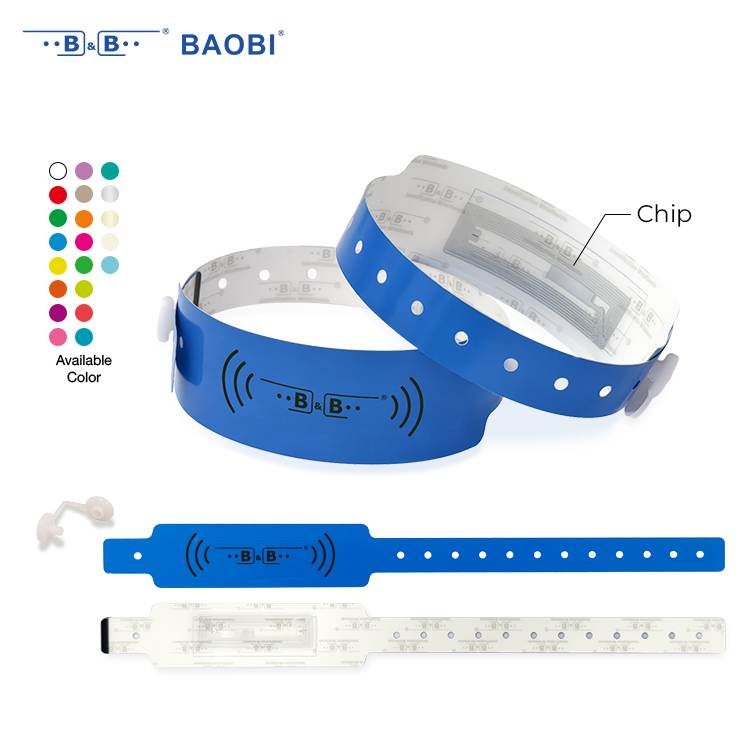
Then there's the RFID side. When thousands of bands pass readers within seconds, a poorly shielded chip can cause misreads or slow down the line. Good wristbands keep the antenna coil embedded between layers, so a crushed crowd doesn't bend it out of shape. If you're stuck at a jammed entry, the bands that hold up aren't just the ones that stay on your wrist—they're the ones that still scan without making security tap your arm twice.
What Happens When a Scanner Fails Mid-Event?
The handheld unit lets out a weak chirp, then the screen snaps to a frozen blur of pixels. For a heartbeat, the volunteer at the gate keeps tapping the trigger, hoping it will revive. It doesn’t. The line behind the rope starts shifting, phone screens dimming as arms tire. No one planned for this exact moment—the scanner dying right as the headliner’s opening chords rumble from the main stage. Within sixty seconds, a manager appears with a laminated sheet of names and a ballpoint pen. Tickets get checked by eye, IDs compared to a printed list that was last updated at noon. People get waved through, but not before a few frustrated sighs and a couple of shouted questions about refunds.
Behind the scenes, the failure isn’t just a line problem. Scan data feeds real-time attendance dashboards, bars tabs, and credential verification. When the device goes dark, every entry after that point becomes a guess. Someone scribbles names on a notepad; someone else tries to restart the scanner using a phone hotspot. By the time the backup unit arrives from the production office, forty minutes have passed and the paper log has coffee stains on it. The numbers won’t match later.
After the event, the debrief gets blunt. Batteries weren’t hot-swapped, the firmware update was skipped, the Wi-Fi router near Gate C had been blinking amber all week. But the real takeaway is smaller and sharper: a scanner failure mid-event doesn’t announce itself—it just quietly turns a smooth queue into a human checkpoint, and every human checkpoint leaks data.
Can They Match Your Event's Look Without Delaying Production?
A vendor's portfolio might sparkle with elaborate stage builds, but the real question is whether their team can recreate that same visual language under your timeline. Matching a look isn't just about having the right drapes or LED panels—it's about knowing how to adapt a design to the venue's quirks, the load-in window, and the crew's actual bandwidth. If they're promising full custom fabrication without asking about your schedule, that's a red flag.
You want a partner who treats your event's aesthetic as a set of constraints to solve, not a wish list to defer. Ask them straight: which elements of the reference style can be built or sourced locally, and which ones require lead time? A capable team will walk you through substitutions that preserve the mood—swapping a custom printed wall for projection mapping, or using modular scenic pieces that assemble faster than a bespoke build—without turning the floor into a construction zone during rehearsal.
The best production companies don't just show you pretty photos; they can explain how every visual choice lands on deadline. If they're vague about labor hours or material procurement, assume their beautiful mockup will become your week-of headache. Insist on a production schedule that ties each design element to a specific delivery date, so the look and the timeline stop competing.
Who Actually Shows Up On-Site When Things Go Wrong?
When a system fails at 2 a.m., the person who arrives isn't a brand or a department—it's usually one tired technician with a van full of spare parts and a phone that won't stop buzzing. That person might be a third-party contractor who has never seen your facility before, or a junior engineer who got the call because everyone above them turned off notifications. The difference between a four-hour outage and a four-day one often comes down to whether that individual can improvise, communicate clearly, and actually locate the breaker panel without a site map.
In many industries, the "on-site" role has shifted away from the original equipment manufacturer. Instead, you get a rotating cast of local service partners, retired specialists working part-time, or even a facilities manager who learned the system by watching YouTube tutorials. The person carrying the toolbox may not have designed the equipment, but they're the one making judgment calls under pressure—deciding whether to patch, bypass, or shut down entirely while the clock runs and costs climb.
That's why the real question isn't just who shows up, but what kind of authority and information they're given before they walk through the door. A competent contractor with a clear escalation path and access to updated schematics will outperform a brilliant engineer who's never been trained on your specific configuration. The next time something breaks, don't assume the name on the service contract matches the face on the ladder.
How Do They Protect Attendee Data From the Moment It's Scanned?
From the first tap of a badge, the scanned data is immediately encrypted on the device and sent through a private tunnel to an isolated event database. It never lingers in local memory, never rides on venue Wi-Fi as plain text, and never gets stored on a volunteer's phone. That split-second handoff is what stops a lost scanner from turning into a full attendee list leak.
Once the data lands, access is carved up by the actual job someone is doing that day. A check-in volunteer can confirm a registration, but they can't open the export panel or search across sessions. Temporary staff get time-limited credentials that expire when their shift ends, and every view of personal details is logged against a named account, not a shared login.
After the event, the raw scan trail is automatically reduced to aggregate counts: how many people entered which hall, not which person went where. Personal identifiers are stripped within a set retention window, and the encrypted source files are destroyed rather than kept "just in case." That way the data has a clear end of life instead of drifting into someone's backup folder.
What Does Their Past Work Reveal About Real-World Entry Flow?
Looking closely at earlier projects often uncovers a telling mismatch between the polished entry flow shown in portfolios and the messier reality users actually face. A designer might showcase a clean sign-up sequence with minimal fields, but the surrounding notes or prototype tests reveal that people hesitated at specific steps, dropped off when asked to verify an email, or struggled to understand what the product did before committing. These subtle signals in past work—like repeated iterations on a password screen or a sudden shift to guest checkout—are more informative than the final screenshots.
Another pattern worth examining is how past projects handled interruptions and context switching. Real-world entry rarely happens in a quiet room with perfect connectivity. Work samples that include offline fallbacks, progress saving, or reduced-friction re-entry after a break indicate that the designer thought beyond the ideal path. Conversely, a portfolio piece that only shows a linear onboarding flow without mentioning error recovery or user drop-off suggests a limited view of entry as a one-time event rather than a recurring, interruptible process.
Ultimately, past work reveals whether someone treats entry as a static set of screens or as a living moment shaped by user motivation, device constraints, and environmental noise. The most useful portfolios don't just display final states; they expose the decisions made under uncertainty, such as why a social login was added after testing or how a multi-step form was compressed without losing clarity. Those traces of reasoning are what separate a generic showcase from evidence of genuine entry-flow understanding.
FAQ
Wristbands should stay readable after being soaked in a water barrel test or baked on a dashboard for a weekend. Ask suppliers to demonstrate with samples, not just spec sheets. The chip and antenna need to survive bending, tearing, and repeated contact with alcohol-based sunscreen.
A good partner will already have a backup reader at every gate, a manual check-in mode, and a technician on call within minutes. If they tell you it never happens, that's a red flag. Ask how they handled a real hardware failure at a previous event.
Not all RFID chips have enough memory or the right frequency for multi-use. You want a supplier who asks about your specific data fields and then suggests encoding schemes, not one who says yes to everything. Test a sample with your own software before committing.
Many suppliers promise four weeks but quietly need six once artwork goes through revisions. Get a written commitment for rush production and shipping, including who pays for air freight if their factory slips. Ask for the name of the production manager, not just the sales rep.
Look for unique ID numbers stored in locked memory, plus a backend that flags duplicate scans in real time. Ask if the supplier has dealt with counterfeit wristbands at a festival before. The answer should include specific anti-cloning features, not vague security jargon.
The worst bottlenecks happen when volunteers don't know how to angle the reader or handle a failed scan. A reliable supplier sends a trainer for a few hours before doors open and leaves quick-reference cards at each gate. Ask for a training outline, not just a promise of support.
Any confident supplier will connect you with past clients. When you call, ask about late deliveries, reader compatibility, and what they'd do differently. If the supplier hesitates or gives you only a generic testimonial, that tells you more than any sales deck.
Conclusion
Sorting out an RFID wristband partner starts with stress-testing their product in conditions that resemble a packed gate. Ask how wristbands hold up when hundreds of people push through at once; flimsy chips or weak straps lead to slow reads and angry queues. Equally important is what happens when a scanner dies mid-event. A supplier should have a clear fallback—spare handhelds, offline mode, or instant replacement—not just a promise that hardware rarely breaks. Customization matters too. You want wristbands that match your event's visual identity, but not if design approval adds weeks to delivery. The best partners can balance branding with tight timelines without cutting corners on print quality or chip placement.
The real test is who arrives when trouble hits. A vendor might sell great wristbands but leave you stranded if no technician is onsite or reachable during your event. Ask directly about support staffing and response time. Data handling is another dealbreaker: from the first scan, attendee information should be encrypted and access-controlled; vague assurances aren't enough. Finally, look at their past work, but don't rely on a polished case study. Ask for references from events similar in size and ask about actual entry flow metrics, not just photos of happy crowds. A trustworthy supplier can walk you through past bottlenecks and how they solved them, which tells you more than a spec sheet ever will.
Contact Us
Contact Person: Bill Xu
Email: [email protected]
Tel/WhatsApp: 8618688898707
Website: https://www.baobitech.com/