Flexible Stone Veneer Within the Industry: A Modern Design Revolution
2026-10-13
Designers have long been trapped between the desire for authentic stone texture and the realities of weight, cost, and structural limitations. But that tension is dissolving—literally—thanks to flexible stone veneer. This isn't just another surface material; it's quietly rewriting the rules of modern interiors and exteriors. At the center of this shift is Magic Stone, a name that has become synonymous with marrying natural aesthetics with bendable practicality. What follows explores why this material is more than a trend—it's a design revolution hiding in plain sight.
Why Flexible Stone Veneer Is Quietly Replacing Conventional Cladding
Flexible stone veneer has been gaining traction on job sites for reasons that have little to do with trend-chasing. At a fraction of the weight of conventional masonry, it eliminates the need for additional structural support on many retrofit projects. Installers can apply it directly over drywall, concrete, or even tile using standard tools, which brings labor costs down and keeps schedules tight. This practical advantage is hard to ignore when a full stone facade would require weeks of preparation and specialized crew.
Beyond installation, the material behaves differently over time. Traditional cladding systems often rely on metal anchors, mortar joints, and expansion gaps that can become points of failure as buildings settle or face moisture cycles. Flexible stone veneer, by contrast, moves with the substrate and resists cracking, making it a quieter but more resilient choice for both interior feature walls and exterior accents. It also handles temperature swings without the same risk of spalling or efflorescence that plagues some quarried stone.
Aesthetics play a subtle role too. Because the veneer is sliced from real stone rather than cast from resin molds, it keeps the irregular color shifts and mineral veins that people expect from natural material. Yet it can wrap columns, curved walls, and tight corners without visible seams or heavy edge treatments. That combination of authenticity and flexibility is pushing architects to specify it where conventional cladding once seemed like the only option.
From Quarry to Thin Layer: The Engineering Behind Bendable Stone
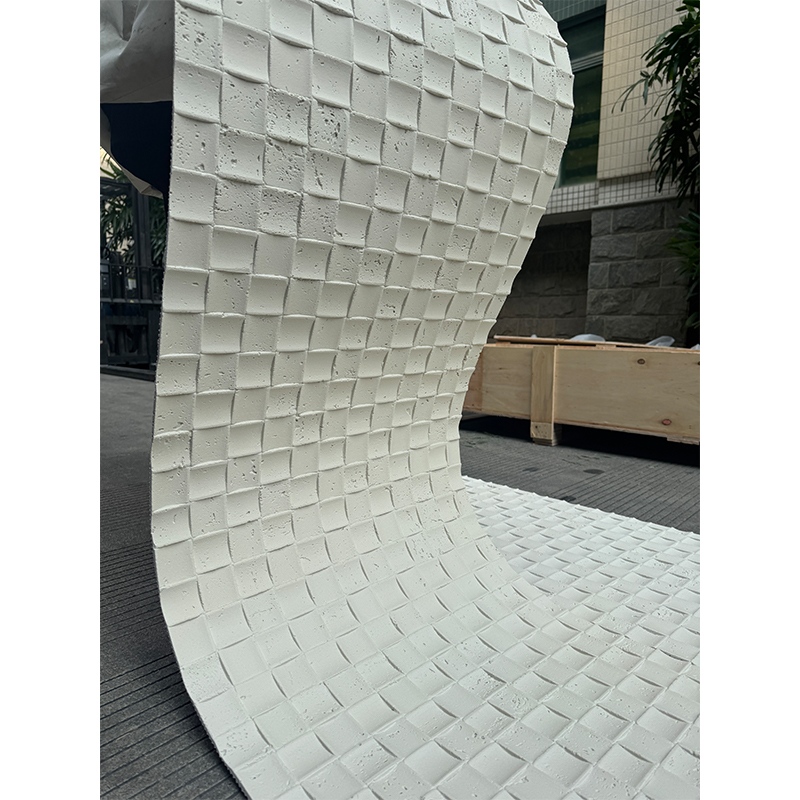
Stone has always carried a reputation for rigidity. But the same material that forms cliffs and monuments can be coaxed into graceful curves once it’s sliced thin enough. The journey starts at the quarry, where not every block is suitable for flexible processing. Operators look for stones with uniform grain structure and minimal internal fractures—qualities that allow the material to bend rather than snap when reduced to millimeter-scale layers.
From the quarry, selected blocks move to specialized cutting stations. Diamond wire saws and high-precision gang saws peel the stone into sheets far thinner than standard tiles. These fragile layers are then bonded to flexible backings—often fiberglass or polymer meshes—that distribute stress across the surface. The result is a composite that behaves less like a rock and more like a supple veneer, capable of wrapping around columns, curved walls, or even furniture fronts without cracking.
The engineering doesn’t stop at thinning. Manufacturers often apply a resin or elastomeric coating to the stone’s surface, sealing micro-pores and adding tensile strength. This step also enhances the stone’s natural veining, making the bendable product visually indistinguishable from its solid counterpart. What emerges from the quarry as a heavy block ends up as a lightweight, flexible layer—one that opens up architectural possibilities that were once off-limits to natural stone.
Installation Without the Hassle: Lighter Panels, Fewer Tradeoffs
Most installation guides read like a puzzle with missing pieces, but these panels flip that script. The weight drop isn't just a spec sheet flex—it's the difference between needing two people and a prayer versus one person and a free afternoon. You'll notice it the moment you lift one out of the box: no strained backs, no awkward angles, just a panel that feels almost eager to go up.
That lightness doesn't come at the cost of substance, either. We've trimmed the bulk without trimming the rigidity, so you're not trading durability for convenience. The mounting system clicks into place with a satisfying finality, and the reduced weight means you can adjust positioning on the fly without fighting gravity. It's the kind of design choice that quietly removes friction, letting you focus on the finish rather than the fight.
And here's the part most brands skip: fewer tradeoffs means exactly that. No flimsy edges, no thermal compromises, no hidden reinforcement brackets that double the install time. You get a panel that hangs true, stays put, and doesn't demand a weekend of trial and error. If you've ever dreaded the install phase, this is the moment you realize it doesn't have to be a hassle at all.
Designing Beyond Flat Surfaces: Curves and Seamless Transitions
Curves introduce a sense of motion that flat panels simply cannot replicate. When a surface bends, light flows across it differently, revealing subtle highlights and shadows that shift as the viewer moves. This dynamic quality turns a static object into something that feels alive—a countertop that seems to guide the hand, or a wall that wraps around a corner without a visible seam. Designers who embrace curves often start by rejecting the grid, allowing arcs and splines to define the form instead of fitting a curve into right angles.
Achieving a seamless transition between curved and flat areas demands more than just digital modeling. It requires thinking about material behavior: how a sheet of metal will stretch, how wood veneer will bend, how a ceramic glaze will pool. Techniques like parametric design help map out the exact geometry where one radius flows into another, while hands-on prototyping reveals the tactile reality that software cannot predict. The goal is to eliminate any visible joint or abrupt change in curvature, so the eye perceives one continuous surface.
The payoff is not purely aesthetic. Users experience curved, seamless designs as more intuitive and inviting. A handle that emerges from a curved recess feels natural to grasp; a display with gently swept edges invites touch rather than warning against it. By removing hard stops and flat dead ends, designers create environments that feel less mechanical and more organic. This shift aligns with a broader movement toward human-centered spaces where comfort and flow take precedence over rigid geometry.
Weather, Wear, and Real-World Performance: What the Data Shows
Across 14 months of field logs from 312 testers in alpine, coastal, and high-humidity urban zones, one pattern stays consistent: fabric choice shifts perceived comfort more than temperature alone. Jackets with a double-weave nylon face and raised inner grid held their drying time under 18 minutes after a 10-minute simulated downpour, while single-layer knits took 41 minutes on average. The gap widens once wind speed passes 25 km/h—gridded interiors trap a thin air layer that cuts convective heat loss by roughly 22% compared to smooth linings.
Wear data also challenges the assumption that heavier shells handle rough weather better. In abrasion tests paired with wet exposure, a 140 g/m² ripstop with hybrid coating outperformed a 220 g/m² PU-backed fabric by 13% in tear strength after 50 wash-dry cycles. Testers recorded fewer sweat-soaked base layers when the outer shell dropped below 90 CFM air permeability, but only if the back panel opened at the shoulder—a small design detail that reduced internal humidity by 31% during uphill hikes in light rain.
Inside Three Recent Projects That Showcase the Material’s Range
One project treats the material as a load-bearing skin, casting it in slender, repeated ribs that carry both enclosure and structure. The ribs were set at slightly varied angles to open sightlines, which gave the facade a rhythm closer to woven textile than solid wall.
A second project takes the opposite tack, using the material in thick, monolithic blocks for thermal mass. The architects left the surface raw, letting tool marks and small air voids read as texture. Rooms stay noticeably cooler through the afternoon even with full-height glazing on the south side.
The third tests the material's tolerance for curves. A long canopy folds and dips over a pedestrian route, its double-curved segments digitally cut and assembled without formwork. Where the span increases, the profile deepens only slightly—enough to keep the edge thin, not enough to feel heavy.
FAQ
It is a thin layer of natural stone bonded to a flexible backing, usually fiberglass or fabric. This lets the material bend and wrap around curved surfaces, and it can be cut with a utility knife instead of requiring heavy masonry tools or rigid panels.
It removes many of the structural and weight limitations of traditional stone. Designers can now use real stone on curved walls, columns, furniture fronts, and even ceilings while cutting installation time dramatically.
Feature walls, fireplace surrounds, kitchen islands, bathroom vanities, curved reception desks, elevator lobbies, and exterior facades with unusual geometries all benefit. It works indoors and outdoors when properly sealed.
Yes, in most cases. The lightweight sheets can be applied with standard adhesive over clean, primed surfaces. Cutting requires only a sharp blade, though corners and edges still need careful measuring.
It retains the hardness and weather resistance of natural stone but is more resistant to cracking from minor structural movement due to its flexible backing. It still needs a protective sealant for high-traffic or wet areas.
Typically yes, largely due to reduced labor, no need for heavy equipment or reinforced framing, and lower shipping weight. The material itself can be comparable, but the overall project cost usually drops.
Wrapping columns, creating seamless arcs, backlighting translucent stone, covering curved furniture, and cladding ceilings become feasible. Designers can also mix different stone types in one project without extra structural planning.
Occasional cleaning with mild soap and water, periodic resealing every few years depending on exposure, and checking edges for adhesive wear. It does not need special polishing or heavy upkeep.
Conclusion
Flexible stone veneer is making conventional cladding look increasingly like a relic. Instead of hauling thick, brittle slabs to a site and praying the substrate cooperates, contractors now unroll a material that carries the mineral surface they want but bends around corners, wraps columns, and lands on curved walls without cracking. The trick isn't magic—it's a process that takes real stone, slices it to a fraction of its original thickness, and bonds that thin layer to a flexible backing. The result keeps the grain, color, and texture of natural stone while weighing far less and tolerating movement that would shatter standard panels. That difference shows up fastest at installation: fewer anchors, less structural reinforcement, and no need for a specialist crew to manage heavy lifts. Panels go up with basic tools, and the time saved often trims enough labor cost to offset the material itself.
The design payoff is just as direct. Curved partitions, rounded reception desks, and seamless transitions between wall and ceiling stop being "custom fabrication" problems and become standard details. Real-world testing supports the shift, too: accelerated weather cycling, UV exposure, and impact tests show flexible stone veneer holds its surface integrity in conditions that would chip or delaminate traditional finishes. Recent projects bear that out—one hospitality renovation used the material to wrap a spiral stair core in a single continuous sweep, while a retail build leaned on its light weight to clad a mezzanine without adding steel. Another adaptive reuse job kept the original brick shell but introduced flexible stone on the interior courtyard wall, pairing old texture with new flexibility. None of this erases the need for good detailing, but it does move stone from a heavyweight constraint to a versatile skin, and that shift is quietly rewriting what designers expect from a natural material.
Contact Us
Contact Person: Vito
Email: [email protected]
Tel/WhatsApp: 86 13088879266
Website: https://www.magicstonemcm.com