GMP Cleanroom Construction Supplier: How to Choose the Right Partner
2026-08-06
Selecting a GMP cleanroom construction supplier isn't just about concrete and HVAC—it's about securing a partner who understands the stakes of contamination control and compliance. Every decision, from airflow design to material selection, can ripple into your product's integrity. That's why forward‑thinking teams turn to specialists like GENO Pharmatech, who treat each build as a living ecosystem rather than a box. But with so many claims of expertise, how do you separate real capability from polished sales pitches? This guide cuts through the noise, giving you practical lenses to evaluate experience, regulatory depth, and post‑handover support—so your facility doesn't just pass inspection on day one, but performs flawlessly for decades.
Beyond Compliance: What Actually Matters in a GMP Cleanroom Build
A GMP cleanroom is more than a box that checks regulatory boxes. While compliance with standards like ISO 14644 and EU GMP Annex 1 is the baseline, the real measure of a successful build lies in how well it supports daily operations. Too often, facilities pass validation but create long-term headaches: cramped layouts that hinder maintenance, material flows that invite cross-contamination despite paperwork saying otherwise, or HVAC systems that meet particle counts but fail to control temperature spikes during peak production. The gap between "compliant" and "functional" is where contamination risks breed, and it's precisely what separates a costly enclosure from a true manufacturing asset.
Material selection is a prime example. Standards mandate cleanable, non-shedding surfaces, but they don't tell you that stainless steel with a No. 4 finish might look compliant yet become a nightmare because cleaning crews struggle to remove residues from its grain, or that certain seamless flooring systems degrade prematurely when exposed to specific disinfectants. Forward-thinking builds go deeper: they mock up rooms and test cleaning regimens under real conditions, often uncovering issues that static material certificates never reveal. It's about choosing surfaces that maintain their integrity not just on day one, but after thousands of wipe-down cycles with the actual chemicals your process requires.
Then there's the human factor — arguably the biggest variable no audit checklist fully addresses. A cleanroom can have perfect pressure cascades and HEPA coverage, but if the gowning sequence feels so cumbersome that staff rush through it, or if pass-throughs are poorly positioned to the workflow, compliance becomes theater. Designing for human behavior means observing how people actually move, where they naturally place their hands, and how to make the cleanest path the easiest path. This level of detail — often involving mock-ups, workflow simulations, and direct operator feedback — transforms a code-compliant room into a space where contamination control is ingrained, not enforced.
Why Track Record Trumps Spec Sheets for Cleanroom Contractors
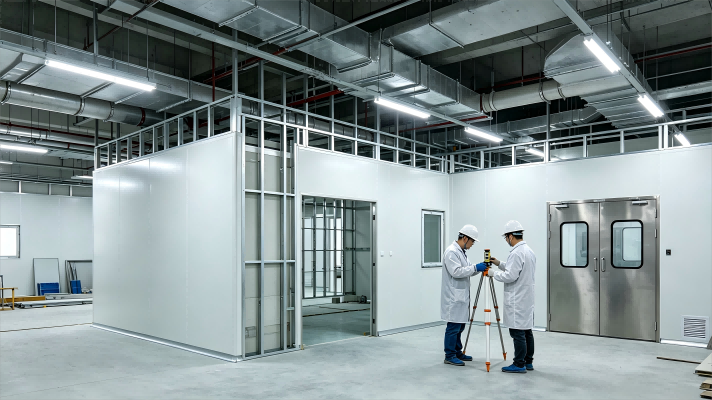
Spec sheets can be deceiving. They often present an idealized version of a contractor's capabilities, filled with impressive certifications, advanced equipment lists, and glossy project photos. But when you're dealing with the stringent requirements of a cleanroom—where even microscopic contaminants can lead to catastrophic product failures—paper qualifications mean very little if they haven't been proven in the field. Contractors who lean heavily on spec sheets may be hiding a lack of actual hands-on experience in your specific industry, whether it's semiconductor manufacturing, pharmaceutical compounding, or aerospace assembly. The differences between a data center and an ISO Class 5 cleanroom are vast, and only a solid track record can confirm that a contractor truly understands the nuances of airflow management, filtration integrity, and material compatibility in such controlled environments.
A strong track record speaks to a contractor's problem-solving abilities when unexpected challenges arise. Cleanroom construction rarely goes exactly according to the initial blueprint. There are supply chain hiccups, site-specific hurdles, and coordination nightmares with other trades. A contractor who has repeatedly delivered successful cleanrooms will have developed a sixth sense for preempting these issues. They'll know, for example, that certain sealants outgas more than their tech data indicates, or that the local humidity patterns require a slight over-spec for the HVAC system. This institutional knowledge doesn't appear on a spec sheet; it's earned through years of troubleshooting and iterative refinement. A contractor with a deep portfolio can point to past projects where they adapted on the fly, ensuring the final validation met or exceeded the required standards.
Ultimately, the decision to trust a track record over a spec sheet is about risk mitigation. A cleanroom failure isn't just an inconvenience—it can halt production, destroy valuable batches, or even lead to regulatory shutdowns. When you choose a contractor, you're not just hiring a construction crew; you're entering a partnership that directly impacts your operational continuity. Checking references, visiting completed facilities, and talking to past clients will reveal the true story of a contractor's reliability, communication, and commitment to quality. These qualitative factors often distinguish a trustworthy partner from one who simply looks good on paper. In an industry where performance is everything, past successes are the most reliable predictor of future results.
Reading Between the Lines: Decoding a Supplier’s Quality Culture
A supplier's true quality culture isn't found in polished presentations or audit-ready documents—it lives in the moments no one prepares for. Listen to how operators talk about their work during a line walk, or watch how a supervisor reacts when a defect surfaces. Do people hesitate to speak up, or does the team naturally huddle around a problem with genuine curiosity? These unscripted interactions reveal whether quality is a daily instinct or a rehearsed performance.
Beyond the production floor, clues hide in the rhythms of the organization. Check the maintenance logs for patterns of quick fixes rather than root cause investigations. Notice if supplier scorecards drive improvement or just accumulation of data. When you ask about a past customer complaint, see if the response points to systemic changes or a temporary patch. Real quality cultures treat every nonconformance as a learning trigger, not a blame trigger, and that mindset echoes from the receiving dock to the executive suite.
The subtlest sign is often in the language. Are quality objectives framed as “zero defects” metrics that breed fear, or as “right first time” principles that encourage ownership? Ask about their proudest quality achievement—if the story revolves around heroic individual effort, it may mask fragile processes. A maturing culture celebrates mundane reliability: a predictable supply chain, a quietly effective error-proofing device, or a team that hasn't had a repeat issue in years. That confidence, worn lightly, is what you're really searching for.
The Partnership Factor: Collaboration Over Transaction in Cleanroom Projects
In cleanroom construction, treating the relationship as a mere transaction often leads to missed synergies and costly surprises. When contractors, designers, and end-users work in silos, the complex interplay of HVAC, filtration, and material compatibility becomes a game of pass-the-blame. True partnership means sitting down before the first blueprint to align on performance criteria that go beyond the spec sheet—discussing how the facility will actually be used, maintained, and adapted over time. One semiconductor fab we observed saved millions by co-developing a custom pressure cascade with their integrator, a solution that would never have emerged from a rigid tender process.
This collaborative approach reshapes risk management. Instead of haggling over change orders when a particle count spike appears, partnered teams share real-time monitoring data and jointly troubleshoot. It's the difference between a supplier who delivers a certified filter and one who helps you redesign the air handling layout to reduce turbulence. In pharma projects, where regulatory compliance is mission-critical, early involvement of commissioning agents and validators prevents the all-too-common scenario of a “finished” cleanroom requiring weeks of rework. Contracts alone can't mandate the proactive problem-solving that happens when stakeholders view the project's success as a shared win.
Hidden Costs and Delays: Questions That Reveal the Real Story
Most project estimates look clean on the surface, but the real costs are often buried in what isn't said. A quote might cover the core task, yet overlook the peripheral work needed to make it function. Without digging deeper, you end up paying for integration, customization, or even basic essentials that were never included. The delays are just as sneaky—optimistic timelines rarely account for approval bottlenecks, supply hiccups, or the simple fact that teams overpromise. Asking questions like, "What typically gets added later?" or "Can you walk me through a real timeline from your last three projects?" can unearth these buried truths before they become your problem.
Vague promises are the breeding ground for budget blowouts. When a provider says "implementation takes 4-6 weeks," they're often quoting the best-case scenario—one where you have zero custom requests and their team moves at lightning speed. The reality is messier: key personnel go on leave, integration points throw curveballs, and hidden prerequisites pop up. Smart clients trade empty assurances for concrete data. They ask for a detailed breakdown of past project phases, including actual start-to-finish durations, not ideal ones. They also hunt for cost creep by asking, "What were the top three reasons past clients paid more than they expected?" Suddenly, the polished pitch meets the unfiltered reality.
The most dangerous phrase in any project is "that's standard" because it often means "that's where we make our margin." Whether it's recurring software licenses, mandatory training, or unavoidable overtime, these surprises drain resources after you're already locked in. The fix isn't just more rigorous questioning; it's asking from a position of suspicion. Instead of accepting "all good," probe for the exceptions: "Under what circumstances would this deadline shift?" or "What's not covered by the warranty?" By reframing the conversation around what goes wrong, you move from being a passive buyer to an informed partner who sees the full picture before signing off.
Future-Proofing Your Facility: Scalability and Innovation in Cleanroom Design
Cleanrooms are no longer static installations built around a single, unchanging process. The pace of technological advancement demands spaces that can adapt without costly, drawn-out renovations. Modular wall systems, movable utility chases, and reconfigurable ceiling grids let you expand, shrink, or reclassify zones in a matter of days rather than months. This kind of scalability means a production line can pivot to a next-generation product, accommodate unexpected capacity needs, or integrate a newly acquired technology without ripping out the entire core, preserving both uptime and capital.
Innovation in cleanroom design runs deeper than physical layout. Sophisticated HVAC controls with variable-speed drives and active monitoring sensors now adjust airflow and pressurization dynamically based on real-time particle counts. Integrating these smart systems with predictive maintenance software cuts down on reactive repairs and extends filter service life. Additionally, material science is quietly reshaping walls and floors—antimicrobial surfaces, low-outgassing polymers, and coatings that resist harsh cleaning agents all contribute to a more resilient, easier-to-maintain environment that keeps pace with evolving contaminant challenges.
Planning for the long term isn't about predicting exactly what the next decade will bring; it's about building in the agility to absorb change. When scalability and thoughtful innovation are baked into a cleanroom’s architecture, the facility becomes an enabler rather than a bottleneck. It can accommodate stricter regulations, novel materials, or shifts in market demand without major disruption. The result is an operation that stays efficient, compliant, and competitive well beyond its initial design horizon.
FAQ
Look beyond the basic ISO 9001. A solid supplier will have ISO 14644 compliance for cleanroom classification, and ideally certifications like ISO 13485 if you're in medical devices, or specific GMP training credentials from recognized bodies. These aren't just paper—they show the supplier has embedded quality thinking into their processes, not just slapped it on for a tender.
Ask for a site visit to an operational cleanroom they built at least two years ago. Talk to the facility manager, not just the project lead. Pay attention to details like pressure cascade stability, surface integrity after wear, and day-to-day operability. If they hesitate or only offer photo galleries, treat it as a gap in transparency.
Be wary if they jump straight into quoting without asking about your process flow, contamination risks, or future scalability. A competent partner will challenge your assumptions and propose alternatives—like suggesting a different HVAC zoning or material choice to reduce particle shedding. Also, check if their in-house team handles critical design or if they outsource it all.
Cleanrooms aren't one-size-fits-all. A supplier who has only built for electronics might underestimate the microbial control needed for sterile pharma. You need someone who asks about your gowning protocols, cleaning agents, and material transfer methods—and then designs accordingly. Without that, you risk a compliant shell that fails in practice.
Get explicit commitments on response times, spare parts availability, and process revalidation. Some builders vanish after handover, leaving you with a black box. Demand a maintenance manual that's actually customized, not generic, and ask for a list of trained technicians in your region. A true partner will proactively schedule performance audits.
Ask how they manage installed component verification—like HEPA filter integrity testing and surface finish inspections. Do they use third-party testing or self-certify? Check if they log all deviations and how they handle non-conformities in real time. On-site construction can contaminate a cleanroom before it's even sealed, so their cleanliness protocol during build matters.
Timeline pressure often leads to corners cut on commissioning and validation. Ask for a detailed schedule that includes buffer periods for iterative testing and regulatory inspections. Probe past projects where they faced delays; their answer will reveal whether they prioritize speed over quality. Also, check if they have enough skilled supervisors allocated, not just sales promises.
It's less about having 'contacts' and more about their track record with authorities. A supplier that regularly interacts with agencies like the FDA or EMA will design with inspection readiness built in—think about documentation, cleanable surfaces, and logical flow. They can also help you avoid common pitfalls that trigger observations, saving you from costly post-construction fixes.
Conclusion
Choosing the right GMP cleanroom construction supplier goes far beyond verifying certifications and checking boxes. What truly separates a dependable partner from a transactional vendor is a deeply ingrained quality culture that permeates every phase of the build. Instead of being dazzled by glossy spec sheets or generic compliance claims, dig into the supplier’s track record—examine how they’ve navigated complex projects, handled unexpected challenges, and delivered facilities that not only meet but exceed regulatory expectations. A supplier’s true capability is often revealed in the details of past work, where consistency, precision, and problem-solving become evident. Equally important is the way they communicate and collaborate; a partnership mindset, where the contractor integrates with your team, asks the right questions, and prioritizes your long-term goals over short-term wins, is invaluable. Watch for subtle indicators of their quality ethos: how they onboard staff, manage deviations, and foster continuous improvement. These cultural markers are far more telling than any polished proposal.
Uncovering hidden costs and potential delays requires a probing approach. Don’t settle for surface-level answers—ask for concrete examples of how the supplier has managed scope changes, material lead times, and validation bottlenecks in previous projects. Their candor and the specificity of their responses will reveal much about their transparency and foresight. Furthermore, future-proofing your facility is not just about leaving extra space; it’s about designing with flexibility for evolving technologies, process changes, and capacity scale-ups. The right partner brings innovative solutions like modular cleanroom components and adaptable HVAC strategies, ensuring your investment remains viable for decades. Ultimately, selecting a GMP cleanroom construction supplier is not a procurement task—it’s a strategic decision. You need a partner who blends technical expertise with genuine collaboration, walks you through the real risks, and builds a facility that supports your quality mission from day one and well into the future.
Contact Us
Contact Person: Amy Yang
Email: [email protected]
Tel/WhatsApp: 008619330882686
Website: https://www.genopharmatech.com/