
OEM Purlin Roll Forming Machine Supplier: Custom Solutions for Efficient Manufacturing
2026-09-09
Struggling to find an OEM purlin roll forming machine supplier that delivers truly custom solutions? At Beenew, we believe efficient manufacturing starts with equipment designed around your specific goals—not generic one-size-fits-all machines. Dive into how our tailored engineering can reshape your production line.
Tailored Purlin Machines for Your Production Line
Every production line has its own rhythm and demands. Off-the-shelf purlin machines often force unnecessary compromises, slowing output or limiting profile flexibility. By engineering systems that align precisely with your operational workflow, material specifications, and space constraints, you gain more than just a machine—you gain a seamless extension of your manufacturing process. This approach eliminates redundant adjustments and lets your team focus on what they do best: producing consistent, high-quality purlins at the pace your projects require.
Customization goes deeper than just swapping out dies or tweaking speeds. It means integrating coil handling, punching, notching, and cutting sequences that match the exact profiles you run daily, without the need for constant manual intervention. Whether you’re dealing with high-tensile steel, unusual web dimensions, or rapid changeovers between purlin styles, a tailored solution prioritizes repeatability and reduces material waste. The result is a machine that anticipates your next move, rather than one that simply reacts to basic commands.
What truly sets a tailored purlin system apart is its ability to grow with your business. Instead of scraping a generic machine when market needs shift, a purpose-built design allows for modular upgrades—adding new profile stations, lengthening run-out tables, or incorporating automated labeling—without a full overhaul. This long-term adaptability minimizes downtime during transitions and keeps your production line resilient, ensuring you’re never locked into yesterday’s limitations.
How Custom Roll Forming Enhances Efficiency
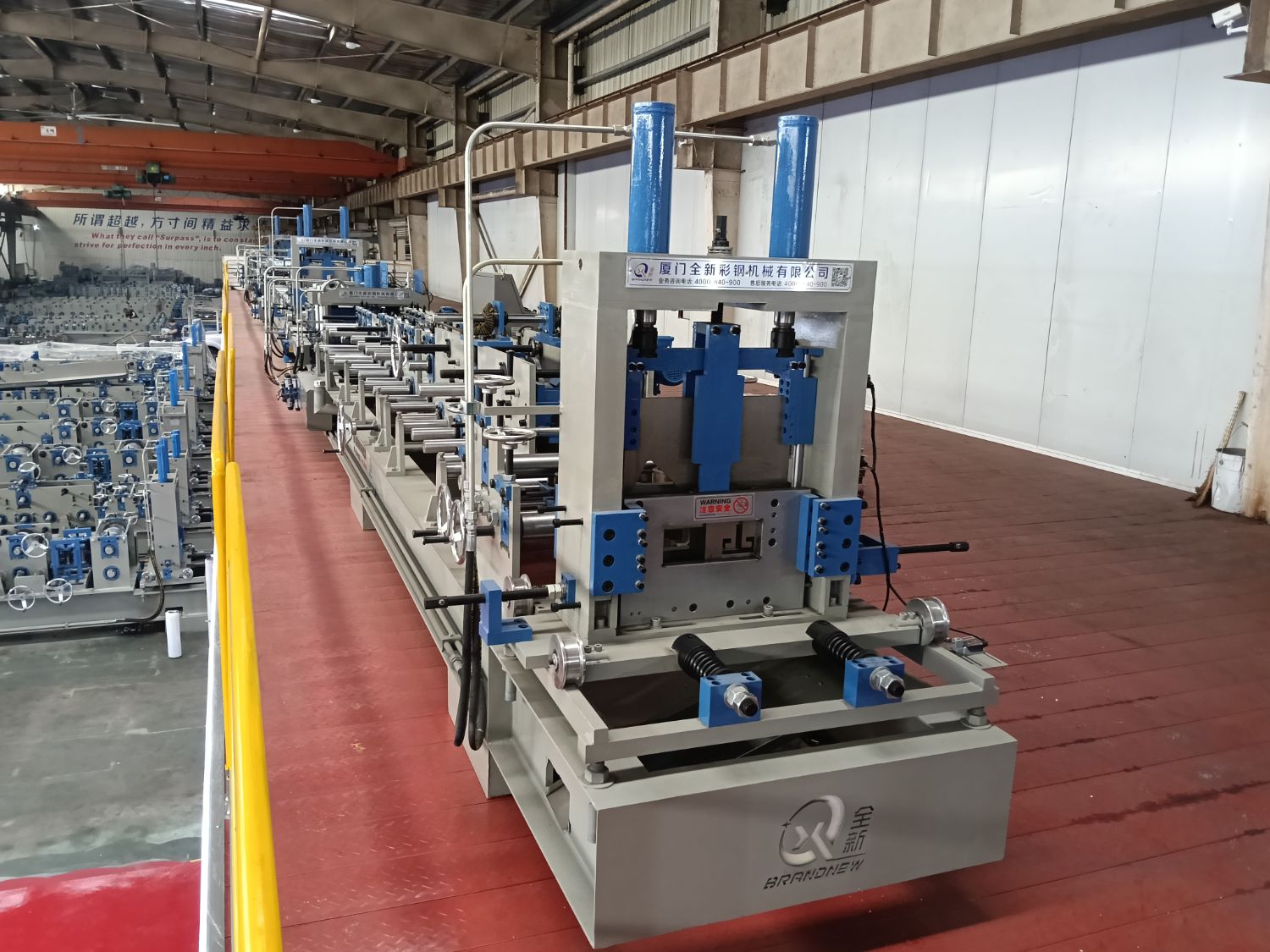
Custom roll forming cuts through production bottlenecks by turning coiled metal into finished profiles in a single, continuous process. Unlike methods that require multiple station setups or frequent handling, this approach feeds material through a series of precisely engineered rollers that gradually shape it—sometimes reaching speeds over 100 feet per minute. The result is a steady output of uniform lengths with minimal operator intervention, freeing up teams to focus on other tasks rather than baby-sitting machinery. For high-volume runs, that consistency translates directly to more product out the door without burning overtime hours or straining equipment.
Efficiency gains also come from smarter material use. Because the process forms rather than cuts away stock, scrap rates can drop below 1%, especially when coil widths are optimized during design. Engineers often fine-tune the roll tooling to nest profiles tightly across the strip, leaving nearly nothing on the floor. This matters most with costly alloys or coated metals where every inch counts—reducing waste not only saves raw material expense but also avoids the extra steps of collecting, recycling, or disposing of offcuts.
The real differentiator, though, is in-line integration. Custom setups routinely combine punching, notching, embossing, or even welding right into the roll forming line. What used to require secondary operations—and the associated transport, stacking, and fixturing—now happens in one smooth pass. That eliminates work-in-process inventory, slashes lead times, and removes the risk of mismatch between formed parts and later features. When downstream assembly receives a part that’s ready to install, the entire manufacturing flow moves faster and with fewer hidden costs.
Engineering Precision for Complex Profiles
When dealing with intricate geometries and tight tolerances, every step of the manufacturing process must be orchestrated to eliminate deviation. Our approach layers advanced CNC programming with real-time metrology, ensuring that even the most irregular contours are reproduced with repeatable accuracy. By mapping toolpaths directly to high-resolution 3D scans of the initial blank, we sidestep the cumulative errors that plague conventional setups.
Precision isn’t just about the machinery—it’s about how you define the problem. Complex profiles demand a shift from standard coordinate systems to adaptive referencing that follows the part’s own geometry. We employ custom algorithms that interpret feature relationships, automatically compensating for thermal drift and material spring-back during multi-axis cuts. This keeps the finished profile faithful to the design intent, not just within a pre-set tolerance band.
The real test comes during assembly, where mismatched profiles can cascade into functional failures. By integrating simulation-driven finishing passes, we pre-empt fitment issues before the part leaves the fixture. Our feedback loops capture in-situ measurement data to refine subsequent batches, creating a living process that tightens with each iteration. The result is a level of consistency that turns challenging profiles into routine production milestones.
Flexible Manufacturing Without the High Costs
For years, manufacturers believed that building flexibility into production lines meant investing in complex, custom machinery. That’s no longer the case. Advances in modular automation and lightweight robotics are making it possible to adapt quickly to changing product demands without breaking the bank. Instead of rigid, single-purpose equipment, companies can now deploy reprogrammable robots and plug-and-play modules that can be reconfigured in hours, not weeks.
Software is playing an equally important role. Cloud-based manufacturing execution systems give small and mid-sized factories the same real-time visibility and control once reserved for large corporations. With simulation tools, engineers can test new production flows virtually before committing physical resources, dramatically reducing trial-and-error waste. The result is a leaner operation where flexibility comes from smart coordination rather than expensive infrastructure.
Real-World Applications of Custom Purlin Systems
Custom purlin systems solve a lot of headaches in construction, especially where off-the-shelf sections just don’t cut it. Large warehouses, for example, may need purlins that can handle uneven roof loads caused by heavy equipment hung from the ceiling or uneven snow accumulation. By adjusting gauge, flange dimensions, and web depth, engineers can dial in the right performance without wasting steel. The result is a set of components that go up faster because they’re made to match the roof’s exact profile, cutting both labor and material waste.
But it’s not just industrial buildings. Custom purlins are a behind-the-scenes hero in many architecturally ambitious projects. Think curved roofs or bold overhangs where standard Z- or C-sections would ruin the clean lines. In agriculture, coatings tailored to resist chemical corrosion keep poultry barns or fertilizer sheds from rusting out in a few seasons. And solar farms rely on precise purlin geometries to mount panels at the perfect angle and survive local wind loads. It’s a simple idea, really: rather than forcing a building to fit the parts, you make the parts fit the building.
What to Expect from a Reliable OEM Partner
A dependable OEM partner acts more like an extension of your own team than a distant supplier. You should expect them to grasp your vision without endless back-and-forth, anticipating needs like a second-nature understanding of your design and production rhythms. This means they'll flag potential material or manufacturing snags early, suggest practical tweaks that align with your budget, and never let a critical timeline slip without transparent, advance warning. Communication here is proactive, not reactive—you'll hear about a supply chain hiccup before it hits the floor, giving you room to adapt.
Beyond meeting specs, a truly reliable partner brings a streak of quiet ingenuity to the table. They won't just reproduce your drawings; they'll notice if a slightly different aluminum alloy could increase durability without cost creep, or if a revised tooling approach could shave days off your launch window. This kind of input comes from deep technical roots and a willingness to share hard-won lessons, not from a scripted sales pitch. It feels like collaborating with a seasoned engineer who genuinely cares whether your product thrives in the real world, not just whether it passes a checklist.
Long-term reliability also surfaces in the less glamorous corners: consistent batch-to-batch quality, swift resolution of the occasional hiccup, and the kind of documentation that makes audits painless. You'll find they keep an eye on macro trends—tariff shifts, raw material markets—so you're not caught off guard. It's the cumulative effect of these small, steady gestures that builds trust. Over time, you stop thinking of them as a vendor and start counting on them as a quiet pillar of your business's resilience, often going above and beyond without fanfare.
FAQ
It continuously shapes metal coils into purlin profiles, like C or Z shapes, used for structural framing in construction. The machine feeds the strip through a series of rollers that gradually bend it into the desired cross-section, then cuts it to length—all in one automated process.
An OEM supplier doesn't just resell machines; they design and build them. That means you get direct access to engineering know-how, the ability to tweak designs to your exact production needs, and often better long-term support since they know the machine inside out.
Instead of settling for a one-size-fits-all machine, you get tooling optimized for your specific profiles, gauges, and output targets. This eliminates costly workarounds, reduces changeover time between profiles, and can dramatically boost your daily throughput without overloading operators.
Most are built for galvanized steel and cold-rolled steel, but a good OEM can set yours up for aluminum, stainless steel, or high-strength low-alloy grades. It comes down to the roll tooling material, drive power, and whether you need features like leveling or pre-punching for tougher materials.
Look for detailed questions about your production floor, not just a brochure. A solid supplier will ask about your typical orders, material specs, and space constraints. Check if they offer on-site visits, reference plants, and whether they own the design files—that's a strong sign you're dealing with a true OEM.
Pre-engineered steel building manufacturers are the obvious ones, but you'll also find them in solar mounting structure production, mezzanine floor systems, greenhouse construction, and even some automotive parts forming. Essentially, any sector needing lightweight structural sections in high volume uses them.
Absolutely. Modern machines can be integrated with uncoilers, automatic stackers, conveyors, and robotic palletizing cells. Many OEM suppliers offer PLC systems with open communication protocols so the roll former becomes just another node in your factory's automation network.
A decent OEM will do more than hand over a manual. They'll typically provide on-site commissioning, operator training, and a clear plan for remote troubleshooting. Long-term, you should be able to get spare parts quickly and even request new profile tooling as your product line evolves.
Conclusion
Choosing an OEM purlin roll forming machine supplier means gaining a partner that understands the unique demands of your production line. Tailored purlin machines are designed to fit seamlessly into existing workflows, eliminating the need for costly modifications. By focusing on custom roll forming, manufacturers can significantly enhance efficiency—reducing material waste, minimizing manual intervention, and accelerating throughput. Engineering precision lies at the heart of these solutions, allowing complex profiles to be produced with tight tolerances and consistent quality. What truly sets a specialized supplier apart is the ability to deliver flexible manufacturing capabilities without imposing high costs, thanks to modular designs and smart engineering that adapt to varied project scopes.
Real-world applications of custom purlin systems span from large-scale industrial buildings to niche architectural projects, where off-the-shelf equipment often falls short. A reliable OEM partner brings more than just machinery; they offer comprehensive support, from initial design consultation to after-sales service, ensuring your investment yields long-term value. Expect transparent communication, on-time delivery, and a collaborative approach to problem-solving. In a competitive landscape, the right supplier empowers you to stay agile, meet evolving market demands, and maintain a competitive edge through efficient, tailor-made manufacturing solutions.
Contact Us
Contact Person: Sophie
Email: [email protected]
Tel/WhatsApp: 8615959271231
Website: https://www.beenew-rollformer.com/