
OEM Solar Channel Roll Forming Machine Company in China for High-Performance Solar Frame Production
2026-09-09
The solar industry is moving fast, and every component counts. If you’re sourcing high-performance solar frames, the roll forming machine behind them can make or break your production line. That’s where China’s OEM specialists come in—but not all are equal. Beenew stands out by pairing precision engineering with deep solar industry know-how. Yet many buyers still struggle to find a partner who truly understands tolerances, material behavior, and the subtle differences between a frame that lasts 25 years and one that quietly fails. In this post, we’ll look beyond generic sales pitches and examine what actually matters when choosing a solar channel roll forming machine partner. Stick around if you’re tired of guesswork and want a clearer path to reliable, high-output production.
Tooling Decisions That Shape Solar Frame Consistency
The smallest burr on a corner die or a half-degree drift in a bending mandrel shows up later as frame twist, uneven glazing channels, or inconsistent screw bosses. Most frame shops chase this with inspection, but the real control point sits further upstream in how the roll forming and punching tools are maintained and matched. A single worn knock-out punch can leave a lip that forces operators to adjust downstream stations by feel, which is where dimensional scatter begins.
Tooling sets that are serialized and tracked by cycle count, not by calendar days, behave differently. When the corner notch and the drain slot are cut by inserts from the same batch, the profile stays square across long production runs. Switch to mixed inserts or regrind one station without verifying the mating punch, and the frame will pass a quick gauge check but fail after lamination or wind load. Consistency is less about the brand of the press and more about how deliberately the tool life is paired to a specific die set.
There is also a quieter failure mode in clamping pressures and guide rail adjustments. Frames that come off the line looking identical can have different residual stress if one fixture is tightened to compensate for a dull blade. That stress releases later as a visible twist at the corner. Shops that record tool change reasons and reject patterns, rather than just tool change dates, tend to spot these interactions before they become field claims.
Why Standard Rollers Fall Short on Solar Channels
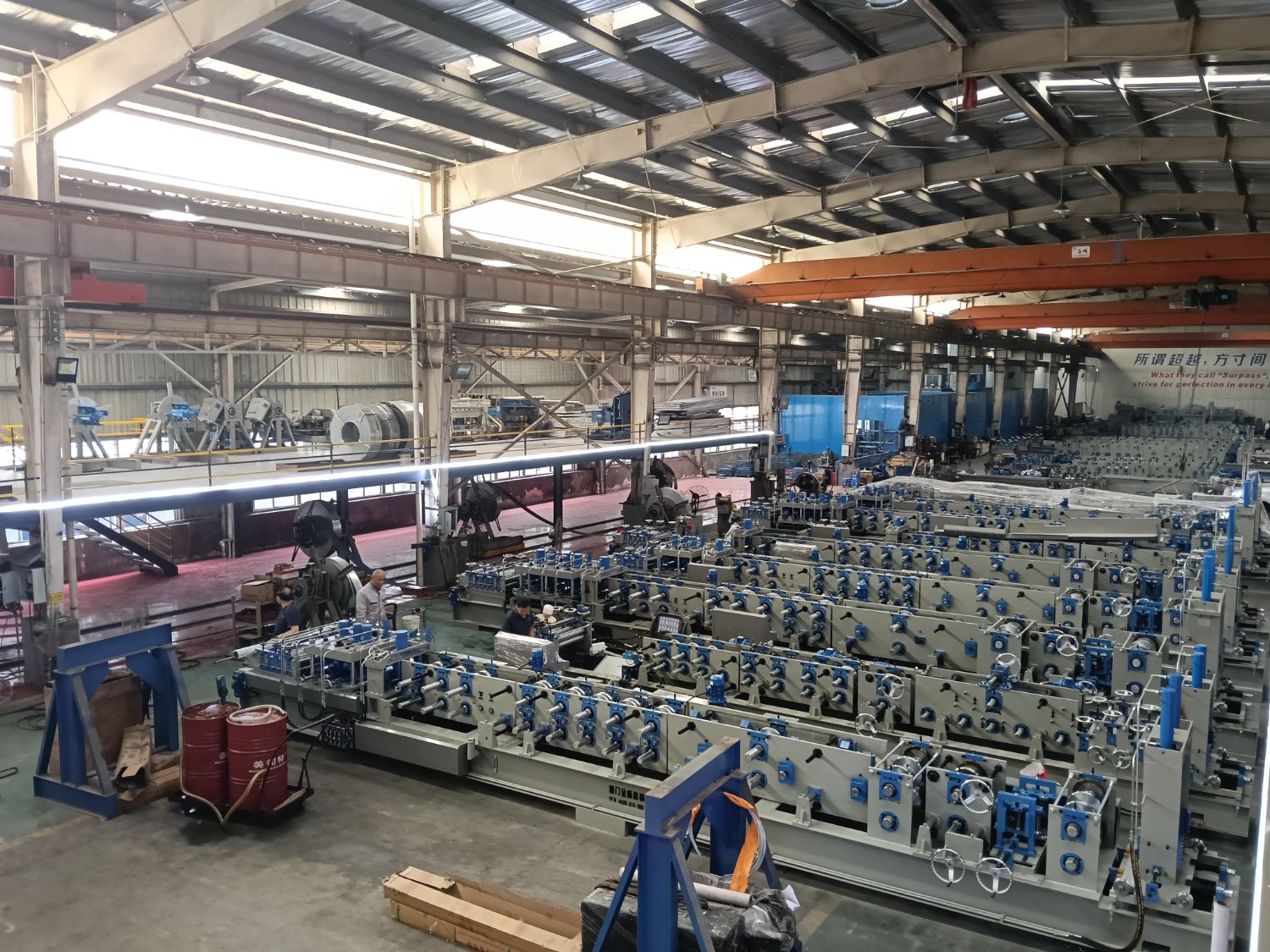
A standard roller set is usually designed around generous bend radii and uniform leg heights. Solar channels break that assumption almost immediately: their cross-sections stack tight corner radii, narrow flanges, and off-center ribs into a single pass. The material does not move evenly through the tooling, so you see the strip wander laterally and the profile twist just enough to jam the next station.
The clearance and coating choices on standard rollers also create trouble. Generic surfaces and wide tolerances may be fine for heavier gauges, but solar channels often use thin-gauge, pre-coated aluminum or high-tensile steel. The result is galling, pickup on the roll faces, and subtle changes in forming angle after only a few hundred feet. Operators then chase the line with shims and speed changes instead of holding a repeatable setup.
Springback is the third, and often overlooked, failure point. High-strength materials and ultra-thin wall sections recover differently after each bend, but standard roll profiles are not compensated for that elastic return. The leg angles come out inconsistent, and as the rolls wear, the gap opens up further. Eventually every channel off the line carries a slightly different geometry, which is exactly what solar mounting systems cannot tolerate.
Inside a Chinese OEM Workflow for Frame Production
When you step onto the floor of a mid-sized OEM factory in Guangdong, the first thing that hits you isn't the noise of machines—it's the quiet coordination. Frame production here rarely follows a single linear path. Instead, orders are split across multiple parallel lines, each tuned to a specific material or finish. A single batch might have aluminum profiles being cut in one corner while steel tubes are bent and welded in another, all under the same roof.
What sets many Chinese OEMs apart is how they handle the handoff between prototyping and mass production. Unlike the long, rigid gate reviews common elsewhere, these workshops often run small pilot lots alongside tooling adjustments. A frame that came off the CNC yesterday might be on a test jig this morning, with tolerance data fed back to the cutting station by lunch. This tight loop lets them catch fit-up issues before they scale, which matters when a client orders ten thousand frames for a folding e-bike or a modular display system.
Quality checks are woven into the flow rather than tacked on at the end. At several stations you'll see simple go/no-go gauges, but also handheld spectrometers for alloy verification and surface profilometers for coating thickness. Workers log results on tablets that sync with the factory's scheduling board, so a spike in weld porosity or anodizing color drift gets flagged in near real time. The result is a workflow that feels less like a fixed assembly line and more like a living system—one that adapts to the frame's geometry, material, and order volume without losing traceability.
Material Choices That Keep Channel Profiles Rigid
Aluminum might seem like an odd starting point if stiffness is the goal, but a well-chosen 6000-series alloy with a thicker web and deeper return legs often outperforms thinner steel sections in real-world channel applications. The key is not just the base metal—it's the temper and cross-section working together. A 6061-T6 channel, for example, resists twisting and buckling under load far better than a generic off-the-shelf extrusion, simply because the geometry and heat treatment are matched to the stress path.
Where weight matters less and long spans dominate, cold-formed steel channels still earn their place. Low-carbon strip with a protective zinc coating gives you predictable yield strength without the price tag of exotic alloys. For harsher environments, stainless grades like 304 or 316 add corrosion resistance without forcing a redesign—though you will trade some machinability. The practical rule is to pick a material that holds its shape when the fasteners are torqued, not one that looks impressive on a spec sheet.
Inline Operations That Remove Costly Secondary Steps
Imagine a CNC machine that drills, deburrs, and polishes a metal part in a single setup. Traditionally, each of those operations would require moving the workpiece to a different station, resetting fixtures, and paying for extra handling. By bringing deburring and polishing tools into the same machining cycle, the inline operation eliminates those costly secondary steps—no forklift trips, no re-clamping, no chance for alignment errors to creep in. The result is a shorter lead time, lower labor cost, and a part that leaves the cell ready for assembly.
Software benefits from the same logic. When a compiler inlines a small function, it replaces the call with the function body itself, removing the overhead of pushing arguments, jumping to another memory location, and returning. In a tight loop that runs millions of times, those eliminated steps translate directly into faster execution. The trade-off is code size, but for hot paths where every microsecond counts, skipping the secondary call ceremony is often the difference between meeting a latency budget and blowing it.
Data pipelines tell a similar story. A naive ETL job writes intermediate results to disk after every transformation—filter, join, aggregate—so each stage pays for serialization, I/O, and storage. An inline approach chains those transformations in memory or streams them through a single pass, never materializing the intermediate tables. The secondary steps of writing and reading parquet files vanish, along with the storage costs and the clock time they consumed. What remains is a leaner pipeline that keeps data moving instead of parking it between stages.
Quality Checks That Go Beyond Dimensional Tolerances
A CMM report can show every hole within a few microns, yet still miss the fact that the casting will crack after three thermal cycles. Real quality checks dig into material behavior—microhardness gradients near the surface, residual stress from machining, or porosity hidden below a machined face. These require destructive sampling, X-ray CT, or eddy current probes that go far beyond a set of calipers.
Fit and function often reveal more than geometry alone. Press a bearing into a housing and measure the force curve; cycle a valve under pressure while recording leak rates; torque a fastener and watch how much preload is lost after vibration. These tests expose tolerance stack-ups, surface finish problems, and lubrication gaps that no drawing dimension can predict.
The best inspection programs treat dimensional checks as just one input among many. They blend lab data, in-process signals, and field returns to refine what matters—so a part that meets every number on the print still gets redesigned if it fails in a customer's hand.
FAQ
Our lines handle a wide range of channel sizes used in solar panel frames, including C, U, and Z profiles with web widths from 35 mm to 120 mm and leg heights up to 50 mm. We adjust roll tooling to match your exact drawing, including holes, notches, and embossments.
You send us profile drawings and production targets. We design the roll forming line around your specs, build and test it at our factory, then ship with installation drawings and remote commissioning support. Ongoing spare parts and tooling changes are handled under the same OEM agreement without rebranding conflicts.
Typical lines run at 15 to 25 meters per minute for galvanized steel or aluminum up to 2.5 mm thick. With servo feeders and flying cutoff, you can hold ±0.3 mm length tolerance while keeping cycle times short enough for high-volume frame assembly.
Yes, in-line hydraulic punching stations are standard options. We position holes, slots, and grounding marks according to your hole pattern, with quick-change die sets to switch between frame sizes in under 15 minutes.
Each line runs dry with your actual coil material for at least four hours. We check profile dimensions, hole positions, surface finish, and cutoff burr height, then provide a full inspection report with video and measurement data before packing.
We ship a complete manual with 3D assembly drawings and step-by-step setup guides. One engineer can join online for live commissioning, and we offer optional on-site training for your operators covering tooling change, alignment, and daily maintenance.
We focus only on solar frame profiles, so the line layout, roll materials, and drive sizing are matched to thin-gauge galvanized steel or aluminum rather than generic building profiles. This reduces twist and spring-back, and the quick-change cassette system lets you switch frame sizes without replacing the entire mill.
Conclusion
In high-performance solar frame production, the difference between a consistent channel profile and a costly scrap pile often comes down to tooling decisions made before the first coil is fed. A Chinese OEM specializing in solar channel roll forming machines understands that off-the-shelf rollers rarely handle the tight corner radii and thin gauges required for solar channels. Instead, they tune each set of rolls to the specific aluminum or steel grade, adjusting forming angles and clearances to prevent springback and edge wave. Material selection gets equal attention: higher-yield alloys and controlled temper keep the channel walls rigid without adding unnecessary weight, which is critical for frame stability under wind and snow loads.
Beyond the tooling and material choices, the actual OEM workflow in China focuses on eliminating secondary operations. Inline punching, notching, and cut-to-length systems are integrated directly into the roll forming line, so finished channels exit ready for assembly without separate drilling or trimming stations. Quality checks move past simple dimensional measurements; laser scanners and vision systems track surface defects, twist, and straightness in real time, flagging drift before it becomes a full batch issue. This combination of custom tooling, rigid material control, inline processing, and deeper inspection is what separates a dependable solar channel roll forming machine builder from a generic equipment supplier.
Contact Us
Contact Person: Sophie
Email: [email protected]
Tel/WhatsApp: 8615959271231
Website: https://www.beenew-rollformer.com/