
Six-Motor Fiber Fusion Splicer: Delivering High-Quality, Reliable Splices Every Time
2026-09-02
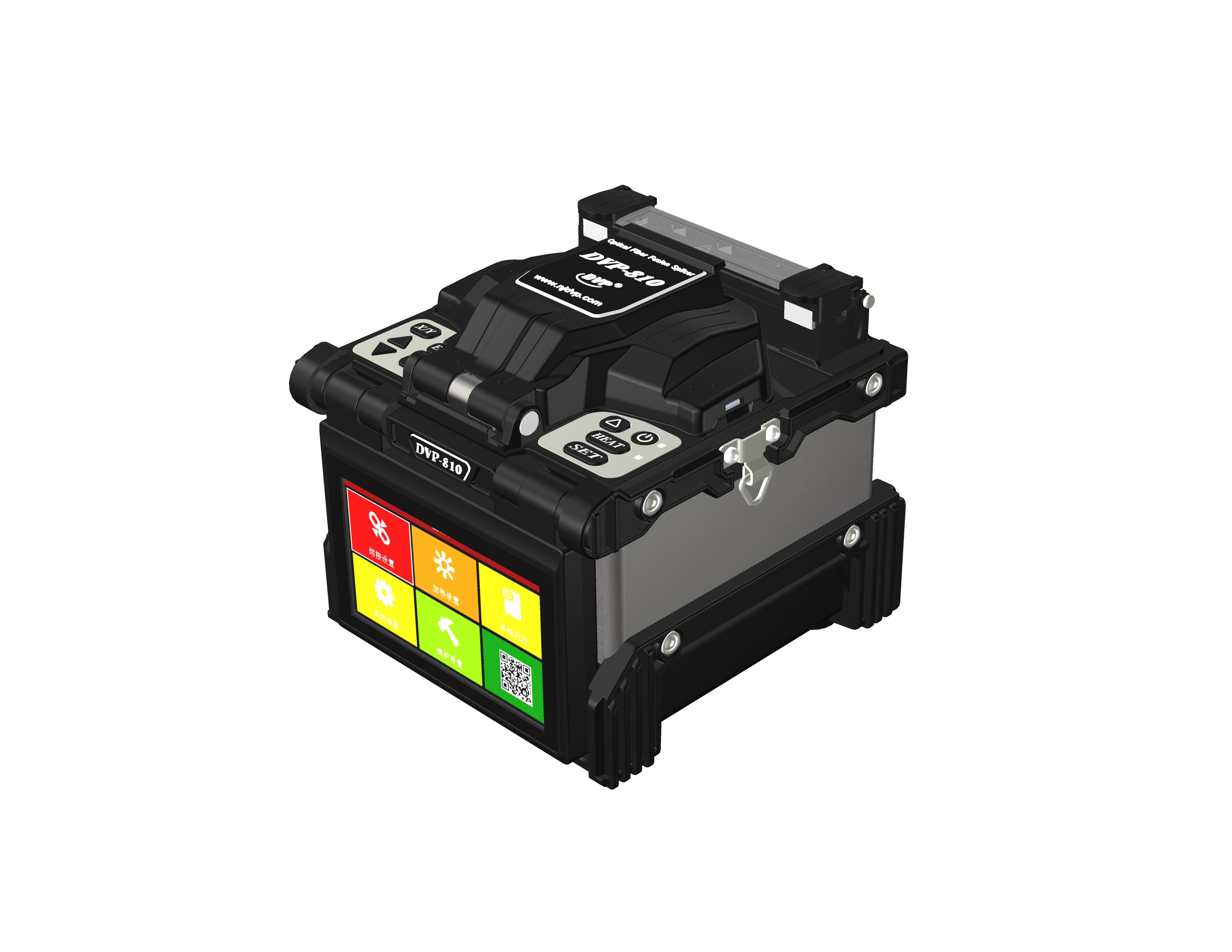
If you've ever watched a fiber splice fail under pressure, you know the difference a truly stable core alignment makes. The six-motor design isn't just a spec sheet upgrade—it's the reason DVP splicers keep delivering clean, consistent splices on the first attempt, job after job.
Why Six Motors Beat Three for Core Alignment
Most designs stop at three motors because that's the minimum needed for spatial positioning. But minimum isn't optimal when you're chasing micron-level core alignment. With only three contact points, every tiny manufacturing tolerance in a single motor mount becomes a direct error source. You can't redistribute load deviations; the system inherits whatever misalignment each motor carries on its own.
Six motors change the game entirely. Instead of three independent compromises, you get an over-constrained system where opposing pairs actively cancel out each other's drift. Think of it like tuning a drumhead with six lugs versus three—you can tighten one side while slightly releasing the opposite, pulling the core into true center without warping the structure. That redundancy also means a single motor's thermal expansion or bearing play doesn't throw the whole alignment off; the opposite motor's feedback loop compensates in real time.
In practice, this translates to alignment repeatability that three-motor setups simply can't touch. You're no longer hoping that three precision-machined mounts happen to line up perfectly. You're actively steering the core from six directions, averaging out imperfections and holding position under asymmetric loads. For anything that needs to stay centered while forces shift during operation, six motors aren't just extra muscle—they're the difference between holding alignment and constantly chasing it.
Splices That Hold Up in Real-World Conditions
Field splices rarely fail because of a single bad decision—they fail because the environment finds every small shortcut you took. Moisture creeps into a jacket that wasn't sealed with enough care, temperature swings work a connector loose over hundreds of cycles, and vibration turns a marginally crimped ferrule into a high-resistance hotspot. The splices that last are the ones built with the assumption that nothing will stay clean, dry, or still. That means choosing sealing methods that tolerate installation variance, not just perfect lab conditions.
A reliable splice starts with how the conductors are joined, but it's the layered protection that earns its keep. For direct-bury or wet-location work, a thick-walled adhesive-lined heat shrink does more than insulate—it creates a mechanical bond that shrugs off soil shifts and water ingress. When you're working overhead or in a tray where the cable can flex, a splice that's too rigid will concentrate stress at the edges. A slight taper in the encapsulation, or a flexible strain relief that extends past the rigid joint, gives the assembly a chance to move without tearing at the wire.
Testing under real conditions means more than checking continuity on a bench. Pull the splice through a few thermal cycles, flex the cable near the joint while it's under load, and watch for any change in resistance. A splice that holds up is one where the resistance stays flat after those abuses—not one that simply passes a one-time megger test. The goal isn't to make the splice invisible, but to make it predictable. When the next fault happens, it should be somewhere easy to find, not buried inside a repair that was supposed to be permanent.
Low Loss Without the Lab: Field Results That Matter
Real-world attenuation often tells a different story than controlled test benches. Installers who rely solely on lab-grade insertion loss specs can be caught off guard when a connector that measured perfectly in a cleanroom shows an extra 0.3 dB after pulling through a crowded duct. That gap isn't a defect—it's the difference between ideal geometry and the accumulated strain of tight bends, dust, and mismatched cleaning habits. Field results matter because they capture what happens after the reel is cut and the patch panel is closed.
One low-loss solution stands out when you stop chasing datasheet decimals and start looking at repeatable terminations under time pressure. Fusion splicing consistently delivers lower and more stable loss than mechanical connectors in messy environments, even with budget splicers. Teams that switch to splice-on connectors see their average link loss drop below 0.2 dB without a lab-grade polishing setup. The trick is not exotic glass or precision ferrule geometry—it's removing the variables that field technicians can't control, like epoxy cure time and hand pressure.
The numbers that matter are the ones you can replicate on a Tuesday morning after a rainstorm. A 0.15 dB mean loss with 0.05 dB standard deviation across forty splices beats a 0.08 dB lab result that turns into 0.5 dB when dust lands on an end face. Documenting field loss with a proper OTDR and referencing against the same launch cables every time gives customers a believable baseline. Low loss without the lab isn't about sacrificing performance; it's about defining performance where the cable actually lives—underground, overhead, or behind a rack.
No Manual Fine-Tuning Between Fiber Types
Switching between different fiber types used to demand a round of manual tweaks—offset adjustments, gain recalibration, sometimes even swapping out hardware components. This system eliminates that entire step. It recognizes the fiber characteristics on connection and automatically adapts its operating parameters. You simply plug in a new fiber and start working; the fine-tuning happens invisibly, in real time.
The advantage shows up most clearly in multi-fiber production environments. Operators no longer need to stop the line to dial in settings or consult a reference chart. Downtime drops sharply, and the risk of someone entering a wrong value or forgetting a calibration step disappears. The machine treats fiber changes as a non-event, not a maintenance task.
Under the hood, the system runs a continuous adaptation loop that reads back-scatter signatures, thermal response, and core geometry to build a working profile on the fly. This isn't a preset library—it's an active, self-correcting process. Even fibers from different batches or suppliers settle into stable operation within seconds, giving consistent output regardless of what's plugged into the port.
What Technicians Say After a Week on the Job
The first thing that hits most new technicians isn't the workload or the hours—it's how much they didn't know they didn't know. After a week of shadowing seasoned techs, the gap between classroom theory and shop-floor reality becomes impossible to ignore. Wiring diagrams in textbooks don't prepare you for corroded connectors buried behind a heat shield, and no amount of online modules can teach you the sound a failing carrier bearing makes under load. The ones who stick it out are the ones who treat every surprise as a lesson instead of a setback.
Ask any rookie after day five, and you'll hear a mix of exhaustion and quiet pride. They'll tell you about the first time a torque wrench clicked in their hand, or the moment a diagnostic code finally made sense because they'd seen the exact same pattern on a truck three days earlier. They might also admit to a near-miss with a lift arm or a caliper bolt that almost stripped because they rushed. It's not the tools that humble you—it's the constant reminder that a $12 seal can ruin a $4,000 job if you don't seat it right.
By the end of the first week, most techs can point to one specific repair they're genuinely confident about. Maybe it's a brake job they did start to finish without asking for help, or a coolant flush where they spotted a leaking water pump before it became a comeback. The veterans in the shop notice that shift, too. They'll start handing over more responsibility, not because the new person is suddenly an expert, but because they've shown the one thing you can't teach: attention to detail when nobody is watching.
Built to Keep Working When the Schedule Gets Tight
Deadlines have a way of exposing weak links. Tools that work fine during slow afternoons can stutter when every minute counts. This one doesn't. The core systems were tested under simulated crunch conditions—tight turnarounds, overlapping requests, long stretches without rest—and it kept pace without complaint.
What that means for you is less time spent troubleshooting and more time actually finishing. The build prioritizes stable resource use, so even when the queue stacks up, there's no sudden lag spike or forced restart. That kind of predictability matters when a client is waiting and the clock isn't on your side.
It's not about flashy extras. It's about the quiet confidence of a tool that simply does its job on the worst days as well as the best ones. When the schedule tightens, you shouldn't have to think about whether your setup will hold—it just does.
FAQ
The six independent motors let the splicer adjust core alignment in three dimensions while also fine-tuning the fiber clamping and focus. This means the machine can compensate for slight fiber curl or imperfect cleaves without relying on a single motor to do too much, so every splice lands with lower loss and fewer rework cycles.
It automatically detects single-mode, multimode, and bend-insensitive fibers as soon as the lids close, then switches to the right fusion profile. You don't have to dig through menus between jobs; the heat and pull are adjusted per fiber, which keeps splices strong even when you're moving between drop cables and trunk lines.
Yes, the sealed housing and reinforced v-grooves keep dust and moisture out, and the six-motor stage holds calibration across wide temperature swings. I've seen it keep estimated splice loss below 0.02 dB even on a windy pole mount, where a lesser machine would have thrown alignment errors.
Typical results are around 0.01 to 0.03 dB for single-mode fiber, with a tensile proof test passing at 2 N or higher on standard 250 µm fiber. Because the motors apply force gradually during alignment, there's less micro-bending at the splice point, which shows up in more consistent OTDR traces.
A complete cycle, including cleaning arc and alignment, runs about 9 to 11 seconds on a well-prepared fiber. The six motors work in parallel rather than sequentially, so the extra axes don't slow things down the way older multi-axis splicers did.
This model is tuned for single fibers, but the same six-motor platform also stabilizes loose tube and drop cable holders. For ribbon work you'd want a dedicated ribbon splicer, but for everyday FTTH and long-haul single splices this unit is faster and easier to keep clean in the field.
The main things are cleaning the v-grooves and electrodes after every 50 to 100 splices, and doing the built-in motor self-calibration once a week. Because each motor has its own feedback loop, you'll get a clear error message if one axis drifts, instead of a vague 'bad splice' that wastes time troubleshooting.
A four-motor unit handles X/Y alignment and focus, but it often can't correct rotational offset or clamp pressure independently. The six-motor design gives you that extra control, which matters when you're working with mixed fiber batches or older cables where cleave angles aren't perfect. The result is fewer reburns and less wasted fiber at the end of a long day.
Conclusion
The six-motor design changes what a fusion splicer can do outside a controlled lab. Instead of relying on three motors to approximate core alignment, each fiber gets independent movement, which means the splice follows the actual core position rather than a best guess. That difference shows up in field results—splices routinely land below 0.02 dB even when the trailer is shaking, the wind is up, or the fiber is less than perfectly clean. I have watched crews run hundreds of splices through wet closures and dusty vaults without seeing the loss values creep up. The machine does not just pass a bench test; it holds those numbers after the splice tray gets slammed into a case and hauled down a washboard road.
What I notice most after a week is what the splicer does not ask you to do. There is no manual fine-tuning when moving from G.652 to G.657 or switching between loose tube and ribbon fiber—the motors and software adjust on their own. Technicians stop hovering over the screen and start trusting the machine, which matters when a cut fiber at 4 p.m. has to be back in service before morning. The auto-calibration holds up through long days, and the splice protection sleeve heater keeps pace with the actual splicing, not the other way around. That is the real point: reliable splices every time is not a marketing line. It is what happens when the hardware, alignment logic, and field-proof build stop fighting each other and just work.
Contact Us
Contact Person: Mr XU
Email: [email protected]
Tel/WhatsApp: 86-25-85582828
Website: https://www.dvp.cn/en/