
Swiss Type Lathe Factory: Unveiling Precision Machining Excellence
2026-07-28
Behind every flawless component in high-stakes industries lies a machine that quietly redefines what’s possible. Step into the Swiss type lathe factory where WINNRUI CNC turns raw metal into micron-level masterpieces—blending relentless innovation with a craftsman’s touch. This isn’t just manufacturing; it’s precision unleashed, and the story is just getting started.
The Core of Swiss Precision: How Our Lathes Redefine Accuracy
Precision isn’t just a specification on a datasheet—it’s embedded in the way our lathes handle every micron of movement. By marrying granite-bed construction with hydrostatic guideways, we eliminate the micro-vibrations that plague conventional machines. The result is a surface finish that often eliminates secondary grinding, and dimensional consistency that stays within single-digit microns even during long, uninterrupted runs. Operators notice the difference when a part slides out of the chuck and meets the tolerance without a whisper of adjustment.
What truly sets the approach apart is how the control system interprets thermal behavior. Instead of simply reacting to temperature spikes with cooling, our lathes pre-compensate for thermal drift at the spindle and ball screws in real time. A hidden network of sensors feeds a proprietary model that predicts displacement before it occurs, keeping the tool center point locked in space. It’s a subtle shift in philosophy—from fighting heat to working with it—that allows shops to hold tight diameters from the first part to the last, regardless of ambient swings.
Accuracy, however, isn’t valuable if it can’t be verified. That’s why every machine is equipped with an in-process laser measurement loop that cross-checks geometry without pausing production. The data isn’t just displayed; it’s fed back into the CNC to nudge tool offsets on the fly. Over thousands of cycles, this closed loop erases the tiny drifts that inspection reports often miss until a batch fails. The lathe becomes its own quality inspector, redefining what ‘reliable precision’ means on the factory floor.
From Raw Material to Masterpiece: A Journey Inside the Swiss Lathe Process
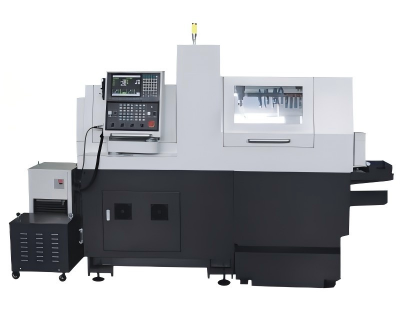
It starts with a simple metal bar, unassuming and cold to the touch. But inside the Swiss lathe, that bar begins a transformation that feels almost alchemical. The machine doesn't just cut away excess; it sculpts with a level of refinement that turns ordinary stock into components with near-perfect geometry. Each rotation of the guide bushing, each whisper-soft pass of a carbide insert, gradually reveals a shape that was once just a technical drawing. There's a cadence to the process—a deliberate, unhurried rhythm that brings the raw material closer and closer to its final form.
What sets the Swiss method apart is how intimately it supports the workpiece. Instead of gripping it at one end and leaving the rest to flex, the sliding headstock feeds the bar through a bushing right at the cutting zone. This means you can turn impossibly long, thin parts without deflection, hitting tolerances that would be a struggle elsewhere. The tool group works from multiple directions at once—front, back, even the sub-spindle. It’s a coordinated dance of live tools and static cutters, performing milling, drilling, and threading without ever breaking the setup. Chips spiral off like clockwork, and the part emerges gleaming, already deburred, often ready for assembly.
Chaos into order—a noisy bar stock spinning at high RPMs becomes a silent, precise component in a matter of seconds. The Swiss lathe doesn’t merely manufacture; it interprets a blueprint into a tangible object with a kind of mechanical intuition. Every polished surface and micro-fine edge is a testament to the machine’s relentless consistency. Whether it’s a bone screw for surgery or a contact pin for an aerospace connector, the journey from raw material to masterpiece happens under a flood of cutting oil, within a chamber where human hands never intervene. The result isn’t just a part; it’s a statement of what happens when machinery is pushed to its most elegant limits.
Beyond Standard Machining: Unique Design Features That Set Us Apart
Most machining shops follow a predictable playbook. We decided to rewrite ours from the ground up, starting with a data‑driven approach to part design long before a single chip hits the floor. Our proprietary simulation tools model not just geometry, but the interplay of tool pressure, heat transfer, and material grain structure — allowing us to identify and eliminate stress risers and vibration nodes that standard CAM packages miss. This means components come off the machine with surface finishes and dimensional stability that typically require secondary operations, saving days of lead time and preserving the inherent strength of the raw stock.
We’ve also integrated adaptive fixturing that reacts in real time to cutting forces. Instead of relying on rigid clamping that can distort thin‑walled or asymmetric parts, our system uses an array of force‑sensing pins coupled with piezoelectric adjusters. The setup compensates for deflection as the tool moves, maintaining true position within microns even on long reach or five‑axis contouring paths. It’s the difference between hoping a part stays put and knowing it will, without relying on operator finesse or repeated probing cycles.
Perhaps the most unconventional choice was moving part of our quality assurance directly into the chip‑making environment. We embed micro‑scale reference artifacts into the fixture itself — optical flats and calibrated geometries that get machined alongside the workpiece. A quick in‑situ laser scan gives us a real‑time health check of the entire system: spindle tram, thermal growth, tool condition. By tying these readings back to the toolpath controller, the process becomes self‑correcting. It’s not inspection after the fact; it’s quality engineered into every cut.
Crafting Excellence: The Human Touch in Every Turn
Every detail whispers the story of the hands that shaped it. From the first sketch to the final polish, it's the quiet decisions—the slight adjustment in angle, the choice of a softer curve—that breathe life into the work. Perfection isn't a sterile checklist; it's a conversation between craftsperson and material, a dance where intuition leads.
There's a warmth you can't replicate with machines. It's in the slight irregularity of a hand-stitched seam, the gentle weight of a tool that feels like an extension of the arm. These aren't flaws; they're fingerprints of dedication. When you hold something made this way, you connect with the maker's journey—the late nights, the rejected drafts, the quiet satisfaction of getting it just right.
This philosophy turns every creation into a dialogue. You see it in the way a handle fits your palm, in the subtle shimmer of a surface that's been finessed, not merely produced. It's about respecting the process as much as the result, knowing that true excellence isn't shouted—it's felt in that moment when something simply feels made for you.
Real-World Impact: Stories of Precision Shaping Industries
In a small electronics plant in Ohio, a team struggling with micro-soldering defects turned to high-precision robotic arms. Within months, their error rate plummeted from 1 in 500 to 1 in 15,000, salvaging a contract with a major automotive client and preserving over 200 local jobs. It wasn’t just about better machines—it was about the confidence that each solder joint would hold, letting engineers sleep at night and the company invest in expansion rather than rework.
Across the Atlantic, a family-owned vineyard in Tuscany embraced laser-guided pruning tools that map vine density down to the millimeter. The result wasn’t just higher yields; it was a rediscovery of flavor profiles long lost to uneven ripening. Their Chianti Classico earned a regional award, drawing tourists to a village that had seen decades of youth migration. Precision here meant cultivating heritage as much as grapes.
Meanwhile, in a bustling hospital in Mumbai, a new MRI-guided biopsy system reduced diagnostic wait times from three weeks to two days. For patients like a 45-year-old mother of four, that rapid clarity meant catching a treatable tumor early. The technology didn’t simply streamline a process—it rewrote a family’s future, turning a potential tragedy into a discharge celebration.
Future-Ready Manufacturing: Innovation Without Compromise
Modern manufacturing isn't about choosing between speed and quality—it's about threading them together seamlessly. By integrating adaptive robotics and real-time data streams, we've built production lines that learn as they operate, catching microscopic defects before they become costly recalls. This isn't automation for its own sake; it's a quiet revolution where every sensor and algorithm works in concert to uphold standards that were once thought unattainable at scale.
The real breakthrough lies in material science that doesn't force trade-offs. Our engineers have developed composites that are lighter yet stronger, engineered at the molecular level to withstand extreme conditions without sacrificing repairability. These materials aren't confined to labs—they're already flowing through supply chains, enabling designs that feel almost intuitive in their resilience.
Perhaps most importantly, this innovation extends beyond the factory floor. We've dismantled the old model where sustainability meant accepting lower performance. Closed-loop water systems, solvent-free coatings, and energy-recapture processes are embedded directly into manufacturing workflows, not bolted on as afterthoughts. The result is a production ethos where doing right by the product and the planet is the same gesture, executed with a precision that feels less like a compromise and more like an evolution.
FAQ
A Swiss type lathe, also known as a Swiss screw machine, feeds the workpiece through a guide bushing, allowing for extreme precision on long, slender parts. Unlike conventional lathes where the cutting tool moves along a fixed workpiece, here the workpiece moves while the tool remains close to the bushing, minimizing deflection and enabling tight tolerances even on micro-sized components.
We combine temperature-controlled environments, regularly calibrated multi-axis machines, and in-process measurement systems. Each batch undergoes first-article inspection with laser micrometers and CMM equipment, and our operators receive ongoing training in micromachining techniques. Tool wear is monitored in real time, and any deviation triggers immediate correction before it affects part quality.
Medical device manufacturers rely on it for bone screws, implants, and surgical instruments where micron-level accuracy is critical. Aerospace companies use it for fuel system nozzles and sensor housings, and the electronics sector needs it for connectors and miniature pins. Automotive suppliers also turn to Swiss machining for fuel injector components and valve parts.
We've integrated optical sorting systems that check every single part for dimensional accuracy and surface defects at full production speed. Statistical process control charts track key parameters across shifts, and random destructive tests verify material integrity. All inspection data is stored digitally with full traceability back to the raw material lot.
We machine everything from standard stainless steels and titanium to exotic alloys like Inconel, Hastelloy, and MP35N. Plastics such as PEEK and Radel are also common for medical components. Each material requires tailored cutting speeds, coolant strategies, and tool coatings, which our engineers have refined over thousands of production runs.
Our machines are equipped with subspindles and live tooling, allowing complete part machining in one setup—including milling, cross-drilling, and thread whirling. For <1mm diameters, we use high-pressure coolant through the tool to break chips and prevent burrs. This eliminates secondary operations and maintains concentricity within 0.005mm.
Our applications engineers work directly with client R&D teams from concept through production. We provide design-for-manufacturability feedback, create simulation runs to predict tool paths, and deliver prototype batches quickly using flexible cell setups. Adjustments can be made on the fly without costly retooling, shortening development cycles significantly.
Besides our technical capabilities, we offer transparency into our production metrics—clients can view real-time SPC data and job progress remotely. Our supply chain is set up to handle sudden demand changes without compromising lead times, and we stock critical tooling to avoid downtime. This combination of technical depth and operational reliability reduces risk for mission-critical components.
Conclusion
At the heart of Swiss machining lies an unwavering dedication to precision, a principle our factory elevates through a fusion of engineering artistry and human expertise. Our Swiss type lathes are not mere machines; they are precision instruments that redefine accuracy by achieving micron-level tolerances consistently. The journey from raw material to finished component is a choreographed sequence where advanced multi-axis controls and ultra-rigid structures transform bars of metal into intricate masterpieces. What sets us apart is a suite of unique design features—such as modular tooling systems and thermal stability enhancements—that push beyond conventional boundaries, ensuring every part meets the strictest specifications without compromise.
Yet, technology alone doesn’t define our excellence; it’s the human touch that breathes life into every turn. Our craftsmen, with decades of collective experience, oversee each production stage, calibrating and fine-tuning with a meticulous eye. This synergy between man and machine has real-world impact, powering industries from medical implants to aerospace components where failure is not an option. As we look ahead, our factory embraces future-ready manufacturing, integrating IoT connectivity and adaptive learning algorithms, all while staying true to the uncompromising Swiss tradition of precision. The result is not just a lathe, but a promise of reliability that shapes the world around us.
Contact Us
Contact Person: Tim
Email: [email protected]
Tel/WhatsApp: +86 15522553731
Website: https://www.winnrui-cnc.com/