
Why Choose OEM Distal Access Catheters for Your Next Medical Device?
2026-10-06
When sourcing components for your next neurovascular or peripheral intervention device, the distal access catheter often dictates procedural success. Yet finding a partner who truly understands the balance between pushability, kink resistance, and atraumatic tip design is rare. That's where INT changes the equation—not as just another OEM supplier, but as a team that treats your catheter requirements as its own clinical challenge. In this post, we unpack the engineering and supply-chain advantages behind choosing INT for your distal access catheter program, and why countless device developers are quietly making the switch.
Your distal access catheter shouldn't start life as a compromise on a stock list
A distal access catheter earns its place the moment it enters the anatomy. If that catheter began as a compromise on a stock list, every push through tortuous vessels amplifies the shortfall. You don't want to adapt your technique to a catheter that was picked for inventory convenience rather than clinical intent.
The wrong starting point shows up in small ways at first—a slightly softer transition, a lumen that fights you, a tip that prefers its own path. Then it shows up in bigger ways: lost time, repeated attempts, and a growing sense that the tool is dictating the case instead of serving it.
Building a distal access catheter around actual procedural demands means treating stock lists as the final step, not the first filter. The goal is not to have a catheter that is easy to keep on the shelf, but one that disappears into the workflow and lets you focus entirely on the patient.
The liner formula you never see still decides how the catheter behaves in a curve
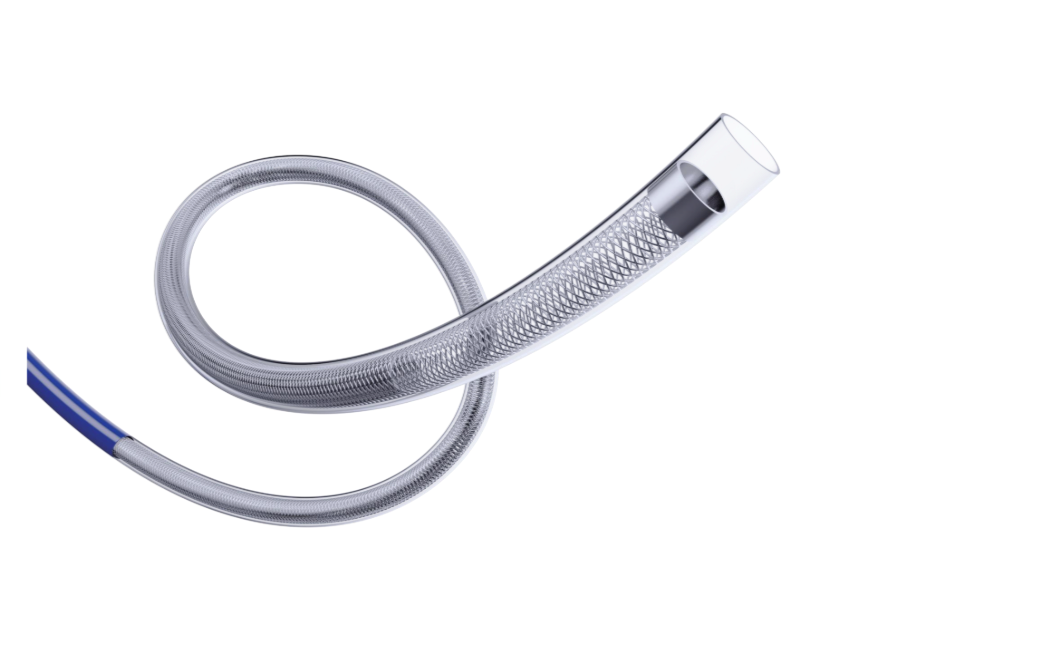
Most people judge a catheter by its outer jacket or tip shape, but the inner liner formula is the quiet variable that sets how the shaft bends. It determines how much the catheter wants to spring back, how much force it takes to arc through a tortuous vessel, and whether that arc stays round or flattens into a kink. A liner tuned too stiff can turn a smooth curve into a buckling point; too soft and the lumen collapses under rotation.
Formulation choices such as base resin, radiopaque filler loading, and processing aids change wall thickness, surface energy, and lubricity. Those microscopic decisions alter the friction between guidewire and lumen, which directly affects pushability and trackability in an angulated takeoff. The formula nobody sees becomes the difference between a catheter that follows the wire through a tight bend and one that ovalizes, stores energy, and loses transmission.
Torque response is something you design for, not something you discover in the cath lab
Torque response is something you design for, not something you discover in the cath lab. When a guidewire or microcatheter finally reaches the lesion, the tactile feedback through the hub should feel predictable, almost boring — that predictability is the result of material selection, distal core taper, and jacket stiffness transitions mapped out long before sterilization. You do not want to be learning the device's character while the patient is on the table.
A lot of operators assume that torque is a property of the wire itself. In reality, it is an interaction between the shaft, the coating, the anatomy, and the accessory setup. Designing for torque means modeling how rotational input degrades over length, how stored energy releases at bends, and how that release either helps or undermines tip control. The cath lab is for validation, not for discovery.
Once you accept that, the design conversation shifts. Instead of asking whether a prototype 'has enough torque,' you ask where it loses fidelity, how quickly it recovers after a bend, and whether the response remains linear through a 180-degree turn. Those questions can be answered on the bench with high-speed imaging and deflection rigs — so by the time it reaches a human hand, there are fewer surprises and more confidence.
A distal tip that holds its shape after multiple passes isn't a small detail
Most tips look perfect out of the package. The real test happens after you've navigated a tortuous curve, withdrawn, and pushed through again. If the tip has started to drift or curl, you lose the tactile feedback that tells you where you are. That tiny change forces you to compensate, slowing down the procedure and adding uncertainty.
A tip that holds its shape isn't just about materials—it's about how the device behaves when you're deep into a case. Repeated passes should feel the same as the first. When the distal geometry stays true, you can trust the trajectory you planned and focus on the anatomy, not on fighting the tool.
Surgeons and interventionalists often don't mention shape retention until they experience a tip that doesn't have it. Then the difference becomes obvious. It's the kind of detail that separates a reliable instrument from one you have to manage.
Cleanroom habits show up halfway through a long thrombectomy
The scrub nurse reaches for a fresh towel without looking, her hand stopping mid-air as muscle memory overrides conscious thought. It’s the third hour of a clot retrieval that refuses to end, and the sterile field has become a second skin. Everyone in the room has slipped into the quiet choreography of a cleanroom: elbows tucked, sleeves never brushing a non-sterile surface, the soft rustle of gowns replacing conversation. Nobody planned it. It just happens when a procedure stretches long enough that the rules stop feeling like rules and start feeling like breathing.
You can mark the moment it shifts. Somewhere after the second guidewire pass, the fellow stops pointing out every potential contamination and instead just moves—opening peel packs with a twist of the wrist, passing syringes with labels already facing the recipient, disposing of sharps in one smooth motion that ends with the cap already snapped. It’s not showmanship; it’s the kind of automatic competence that only emerges after dozens of hours under the same glaring lights. The room isn’t cleaner than before. It’s that nobody has to think about being clean anymore.
The odd part is how invisible these habits become to the people using them. A circulating nurse will step out to fetch a forgotten balloon and, without prompting, hold the door with a foot while keeping both gloved hands pressed to her chest, sterile field intact in her mind even though she’s no longer in it. Nobody comments. Nobody praises it. It’s just the cleanroom leaking into the hallway, a set of instincts that started in training and now surface exactly when the brain is too tired to run the usual checks. In a long thrombectomy, that’s usually halfway through—right when the patient can least afford a break in technique.
Your OEM partner should know the route from the groin to the target vessel better than anyone
Mastering the vascular pathway from femoral access to distal targets isn't just a clinical skill—it's an engineering discipline. An OEM partner that truly understands the twists, turns, and resistance points along this route can design catheters and guidewires that behave predictably in the hands of interventionalists. This means anticipating how vessel curvature, bifurcation angles, and lesion morphology affect device torque, pushability, and tip response before a single prototype is built.
That anatomical fluency shows up in the details: a distal shaft that softens at the right segment to avoid vessel trauma, a braid pattern that preserves lumen while resisting kinking through tortuous iliac anatomy, or a coating that reduces friction exactly where friction spikes. When an OEM partner has walked this route in design reviews, bench tests, and physician collaborations, their components don't just meet specs—they align with the way operators actually navigate the body.
Look for a partner whose engineers can speak the language of vascular access without a glossary. Ask them about the trade-offs between crossing profile and trackability in the common femoral to superficial femoral transition, or how they handle push force decay across the aortic bifurcation. Their answers will tell you whether they're just machining parts or engineering real solutions for the journey from groin to target.
FAQ
A standard product forces you to adapt your device design around its fixed dimensions and performance. An OEM catheter is developed around your specific anatomy targets, device compatibility needs, and procedural workflow. That translates to fewer compromises during integration and a smoother path through verification testing.
You can control nearly every aspect, from inner diameter and length to distal tip shape, durometer transitions, radiopaque marker placement, and hub configuration. Many teams start with a rough sketch or a set of clinical requirements, and the OEM partner translates that into a manufacturable design with iterative prototyping.
Not necessarily. While a fully bespoke design can take longer than buying a stock catheter, working with an OEM that has existing platform technologies and rapid prototyping capabilities can compress the timeline. Often the custom work runs parallel to your device development, so the catheter is ready when you need it for design verification.
It depends on the target anatomy, but common priorities include a soft, atraumatic distal tip, good torque response for navigation, a low-friction inner liner for smooth device delivery, and a kink-resistant shaft. For tortuous distal vessels, you want a catheter that tracks well over a guidewire without buckling, while still offering enough proximal support.
The inner diameter and liner material are tuned to reduce friction and allow smooth passage of your device. During development, you can test the catheter with the exact guidewires, stents, coils, or aspiration systems you plan to use, and adjust the design if there's excessive drag or hang-up at the distal segment.
Look for a supplier with ISO 13485 certification, cleanroom manufacturing, and a solid track record of supporting regulatory submissions. They should be able to provide full material traceability, biocompatibility data, and design history documentation. That level of support takes a big load off your regulatory affairs team.
It can be, if you choose the right partner. Tooling and development costs are usually amortized over the production volume, and a well-designed catheter can reduce downstream issues like device incompatibility or poor clinical performance. Many OEMs offer phased development programs that let smaller companies manage cash flow while still getting a custom solution.
Conclusion
A distal access catheter that earns its place in your device program rarely starts with a generic off-the-shelf selection. When you work with an OEM partner, every dimension, durometer transition, and braid angle is mapped to the actual vessel path, not fitted to whatever happens to be on a stock list. The liner formula—often invisible in a finished product—is where curve behavior is decided long before the first thrombectomy. A low-friction liner with the right stiffness profile keeps the catheter tracking smoothly through tortuous anatomy instead of buckling or ovalizing. Torque response falls into the same category: it is engineered into the shaft build from the proximal hub to the distal segment, so the tip rotation you command is the tip rotation you get, without waiting to discover a dead zone in the cath lab.
Distal tip integrity after repeated passes matters more than it seems; a tip that loses its curve halfway through a case can force device exchanges and add procedure time, so OEM partners test tips through simulated passes and re-shape cycles. Cleanroom discipline is not a marketing bullet point—it surfaces when a long thrombectomy demands consistent lumen cleanliness, low particulate burden, and reliable packaging that opens without surprises. Finally, an OEM partner who understands the route from the groin to the target vessel, including common variants and challenging arches, brings a level of anatomical insight that changes design conversations. That combination—custom specification, predictable torque, durable tip geometry, clean manufacturing, and vascular navigation experience—is why more teams choose OEM distal access catheters for their next device rather than accepting a stock compromise.
Contact Us
Contact Person: Jeffrey
Email: [email protected]
Tel/WhatsApp: 86-0633-2230056
Website: https://www.sd-intmedical.com